OBBBA Student Loan Limits: New Caps & Professional Degree Rule
For families funding graduate education — and for the future CPAs among them — OBBBA’s federal student loan limits are a planning event. The law lowered how much many graduate students can borrow from the federal government and, critically for our profession, the Department of Education’s final rule did NOT classify accounting as a “professional degree.” That means accounting graduate students face the lower $100,000 aggregate federal cap, not the $200,000 professional cap.
At SW Accounting & Consulting Corp, we advise Los Angeles area families on education financing within a broader tax and cash-flow plan. Below: what OBBBA changed, the new borrowing limits, which degrees made the “professional” list, why it matters for accounting students, and how to plan for the federal-loan gap.
What did OBBBA change? 📜
OBBBA placed limits on federal student loans and directed the Department of Education to identify which “professional degree” programs are eligible for higher federal lending limits. The DOE then issued a final rule defining that list and setting the new caps.
Context behind the change (per DOE):
- Graduate borrowing is a large share of the portfolio — the DOE notes graduate students have received more than half of all new federal student loans in recent years and make up about 50% of the outstanding $1.7 trillion federal student loan portfolio.
- Stated goal — the DOE contends the change will help drive down the cost of graduate programs and reduce the debt students take on.
- Public process — roughly 65,000 comments were submitted during the public comment period on the spending-and-tax-bill rules; DOE reviewed comments before issuing the final regulation.
What are the new borrowing limits? 💰
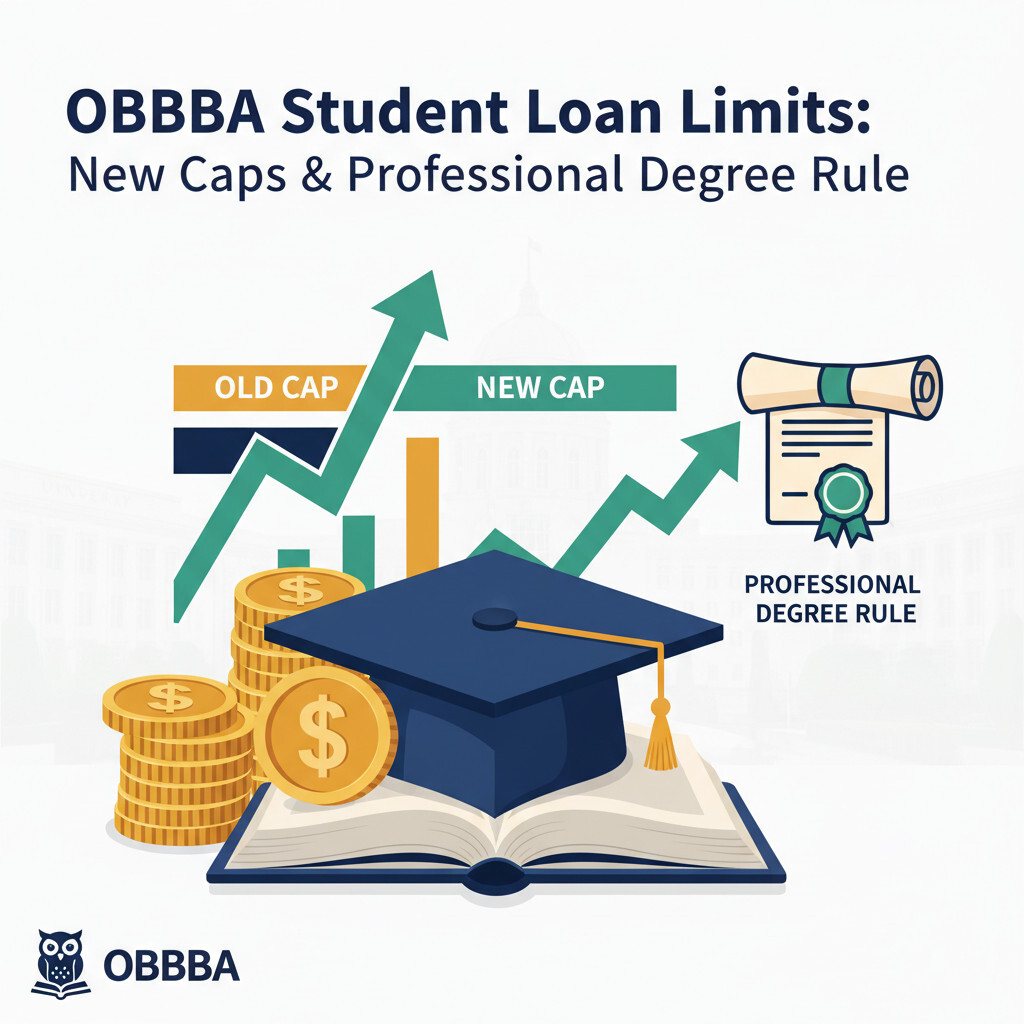
The borrowing cap now depends on whether a program holds the “professional degree” designation. Professional programs keep higher limits; all other graduate and doctoral programs face materially lower caps.
| Program type | Annual limit | Aggregate limit |
|---|---|---|
| “Professional degree” (11 designated fields) | Up to $50,000/year | Up to $200,000 |
| Other graduate / doctoral (incl. accounting) | Up to $20,500/year | Up to $100,000 |
A non-“professional” graduate student can borrow up to $20,500/year federally versus $50,000/year for a designated professional program — and $100,000 vs. $200,000 over the program. For high-cost graduate degrees, that difference often has to be filled with private loans (different rates, terms, and protections) or out-of-pocket funds. Build the gap into the financing plan before enrollment, not after.
Which degrees count as “professional”? 🎓
The DOE’s final rule narrowed “professional degree” to a set of 11 fields — including medicine, dentistry, law, and theology. Notably, the rule does NOT include accounting, and also excludes several healthcare fields.
| Designated “professional” (higher limits) | Excluded (lower limits) |
|---|---|
| Medicine, dentistry, law, theology, and other high-cost programs among the 11 designated fields | Accounting, nursing, social work, physician assistant studies, physical therapy, occupational therapy, and other graduate/doctoral programs |
Note: a multistate coalition of attorneys general has challenged the DOE rule in federal court (U.S. District Court for the District of Maryland), arguing the narrowed definition restricts loan access for advanced-degree students in excluded fields. The litigation is ongoing, so the final scope of the designation could still be affected.
Why does this matter for accounting students? 🧮
Becoming a CPA generally requires 150 semester units — typically a year of graduate-level coursework beyond a bachelor’s degree. Because accounting is NOT on the “professional degree” list, students pursuing that extra graduate work face the lower $100,000 aggregate / $20,500-per-year federal cap.
Practical implications for the CPA pipeline:
- Lower federal ceiling — accounting master’s and 150-unit-bridge students rely on the $20,500/year federal limit, not the professional $50,000.
- Funding-gap planning — the difference may require employer tuition assistance (e.g., IRC §127 programs), scholarships, 529 plan funds, or private loans.
- Employer leverage — firms recruiting CPA-track talent may expand education-assistance benefits to offset the reduced federal borrowing room.
How should families plan? 🧭
With federal borrowing room reduced for most graduate programs, the financing plan needs to be built before enrollment — combining tax-advantaged savings, employer benefits, and (only as needed) private loans.
- 529 plans — qualified withdrawals for graduate tuition remain tax-free; coordinate timing with the loan plan.
- Employer educational assistance (IRC §127) — employer-provided assistance can be excluded from income up to the statutory limit; valuable for working CPA-track employees.
- Private loans as the last layer — compare rates, repayment terms, and the loss of federal protections (income-driven repayment, forgiveness programs) before borrowing privately.
- Model the full cost — map total program cost against the federal cap to size the gap precisely, then fill it deliberately.
Frequently asked questions about the OBBBA student loan changes
It depends on the program. Designated “professional degree” programs: up to $50,000/year and $200,000 aggregate. All other graduate/doctoral programs: up to $20,500/year and $100,000 aggregate. Confirm the current effective date and your program’s classification.
No. The DOE’s final rule did not include accounting among the designated “professional degree” fields, so accounting graduate students face the lower $100,000 aggregate federal cap.
Possibly. A multistate attorneys-general coalition has challenged the rule in federal court (D. Md.). The litigation is ongoing, so the designation’s final scope and effective date could be affected. Plan with current rules but watch for updates.
Common sources: 529 plan funds (tax-free for qualified tuition), employer educational assistance under IRC §127, scholarships, and — as a last layer — private loans. Weigh the loss of federal protections before borrowing privately.
How can SW Accounting help? 💼
At SW Accounting & Consulting Corp, we help LA-area families build graduate-education financing plans within their broader tax picture — coordinating 529 withdrawals, IRC §127 employer assistance, and the federal-vs-private loan mix under the new OBBBA caps. For employers, we help design education-assistance benefits that attract CPA-track talent now that federal borrowing room has narrowed.
📩 Schedule an education-financing & tax planning review
Disclaimer: This article is for informational purposes only and is not legal or tax advice. Always consult a qualified professional regarding your specific facts. Primary sources: One, Big, Beautiful Bill Act (Pub. L. No. 119-21); U.S. Department of Education final rule on “professional degree” classification and federal student loan limits; Internal Revenue Code §127; IRC §529. Litigation reference: multistate challenge filed in the U.S. District Court for the District of Maryland.