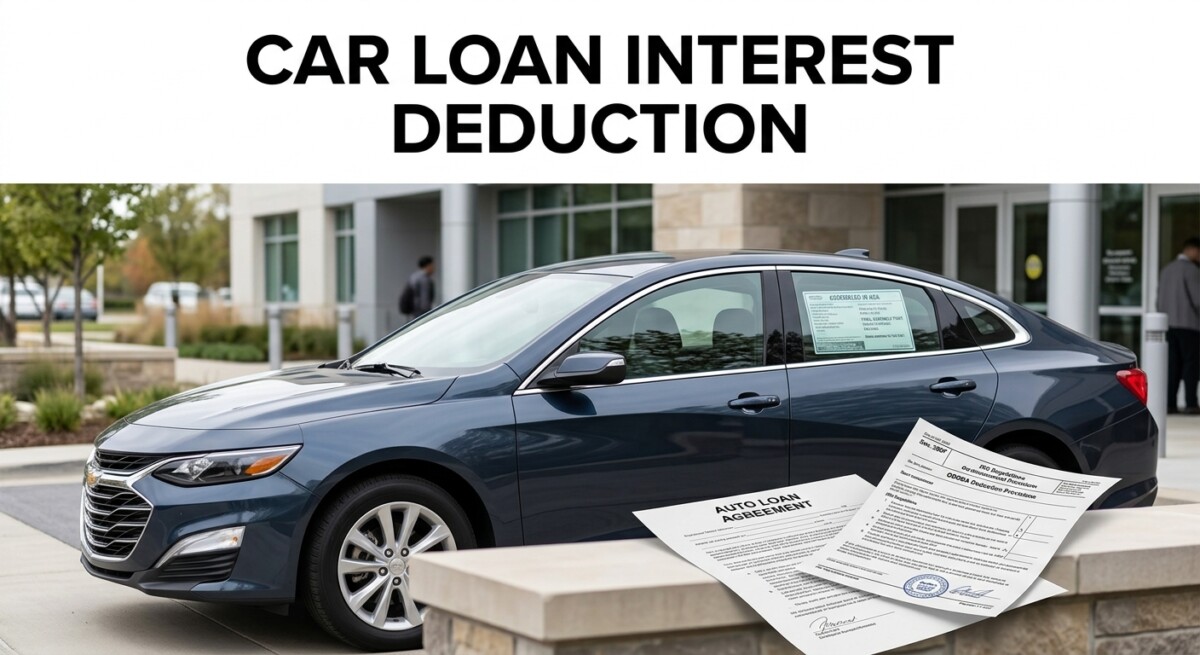
Car loan interest deduction: what do IRS final regs say?
For twenty-plus years, personal car loan interest was flatly non-deductible under §163(h). That changed on July 4, 2025 when the One, Big, Beautiful Bill Act (OBBBA) added a temporary exception for qualified passenger vehicle loan interest, and it changed again on September 8, 2026 when the IRS and Treasury published the final regulations in the Federal Register. This post walks through the car loan interest deduction as the final regulations now define it: what the deduction actually is, which vehicles and loans qualify, how the dollar cap and the MAGI phaseout interact, and what the new §6050AA reporting means for dealers, banks, and credit unions that finance personal auto purchases. The Federal Register final rule (TD 10054) is the authoritative source and should be consulted for the operative regulatory text.
What is the OBBBA car loan interest deduction? 🚗
It is a temporary above-the-line deduction, up to $10,000 per return per year, for interest on a personal-use auto loan you took out on or after January 1, 2025. It applies to taxable years 2025 through 2028 and phases out at higher incomes.
The statutory framework is straightforward. Public Law 119-21 (OBBBA) §70203 amended §163(h) — the long-standing rule that personal interest is nondeductible — by carving out a new category called qualified passenger vehicle loan interest (QPVLI). §70203(b) then amended §63(b) so the deduction is available whether or not you itemize, adding it to the short list of above-the-line write-offs. §70203(c) added §6050AA to the Code, which requires an information return for interest received in a trade or business on these loans.
The final regulations, issued as 26 CFR §1.163-16 and §1.6050AA-1 by TD 10054, adopt the proposed rules with some clarifying changes. The regulations are effective November 9, 2026, and the deduction itself is available for taxable years beginning after December 31, 2024 and before January 1, 2029. Absent further legislation, it disappears after the 2028 tax year — a four-year window, matching the sunset provisions elsewhere in OBBBA.
Because §63(b)(7) makes QPVLI an above-the-line deduction, it reduces adjusted gross income and is available even to taxpayers who claim the standard deduction. For a household that would not otherwise itemize, this is the entire benefit of the provision. For a household that already itemizes, it stacks on top of Schedule A.
Which vehicles qualify as an applicable passenger vehicle? 🔍
A car, minivan, van, sport utility vehicle, pickup truck, or motorcycle with a gross vehicle weight rating below 14,000 pounds whose final assembly occurred in the United States, and that you bought for personal use in the loan on which the interest is paid.
The statute defines applicable passenger vehicle (APV) in §163(h)(4)(D) by six requirements, and the final regulations elaborate each. The vehicle must be one of the enumerated categories, must be manufactured for use on public streets, must have at least two wheels, must have a GVWR less than 14,000 pounds, and must have had its final assembly in the United States. The regulations look to Environmental Protection Agency (EPA) classifications for the categorical definitions, and adopt the vehicle information label (the window sticker) as the ordinary way to establish place of final assembly.
| Requirement | Rule | Practical effect |
|---|---|---|
| Vehicle category | Car, minivan, van, SUV, pickup truck, or motorcycle, per EPA-based definitions. | Heavy trucks, semis, ATVs not designed for streets, and travel trailers are excluded. |
| GVWR | Less than 14,000 pounds. | Most consumer light-duty vehicles qualify; commercial-grade heavy pickups over the limit do not. |
| Original use | The taxpayer must be the original user, subject to a limited dealer-inventory exception. | Interest on a used-vehicle loan generally does not qualify because a used car is not in original use. |
| Final assembly | The vehicle’s final assembly must have occurred within the United States. | Foreign-assembled models are out even if the loan and buyer are otherwise eligible. |
| Personal use | The vehicle must be bought for personal use, not for a trade or business. | Business-use financing is deducted, if at all, under the ordinary trade-or-business rules of §163. |
| First lien | The loan must be secured by a first lien on the vehicle at the time the debt is incurred. | Unsecured loans, home-equity lines used to buy a car, and second-lien financing do not qualify. |
The final regulations also refuse several requested expansions. Commenters asked the IRS to raise the 14,000-pound GVWR ceiling, to broaden the EPA-based definitions of SUV and pickup truck, and to open the deduction to used-vehicle loans. The IRS declined each of those, holding that the statute controls and cannot be rewritten by regulation. Where the statute left room, the regulations do give: they include ordering rules for the dollar cap when a taxpayer has loans on more than one qualifying vehicle, and a substitute-vehicle exception where an unforeseen event, such as a totaling loss, forces the buyer to move to a different APV.
What are the dollar cap and MAGI phaseout? 💵
$10,000 of interest per return per year, phased out at $200 for every $1,000 of MAGI above $100,000 for most filers and above $200,000 for joint filers. The deduction is fully gone at $150,000 MAGI single and $250,000 MAGI joint.
§163(h)(4)(C)(i) caps the deduction at $10,000 of QPVLI on all specified passenger vehicle loans combined. §163(h)(4)(C)(ii) then reduces that ceiling for higher-income taxpayers. The final regulations reject a suggestion to give heads of household their own phaseout floor: Congress specified only two thresholds, $100,000 and $200,000, and Treasury cannot manufacture a third. Heads of household therefore use the $100,000 threshold.
| Filing status | Phaseout starts | Deduction fully phased out |
|---|---|---|
| Single / head of household / married filing separately | MAGI > $100,000 | MAGI ≥ $150,000 |
| Married filing jointly / surviving spouse | MAGI > $200,000 | MAGI ≥ $250,000 |
The math inside the phaseout window is worth reading carefully. Every $1,000 of MAGI over the threshold, or any fraction of $1,000, knocks $200 off the otherwise-allowable QPVLI. So a joint filer at $220,001 MAGI who paid $10,000 of qualifying interest loses $200 for each of the $21,000 in excess (rounded up in $1,000 increments) — that is a $4,200 reduction, leaving a $5,800 deduction. A single filer at $130,000 MAGI who paid $10,000 of QPVLI loses $200 × 30, or $6,000, leaving a $4,000 deduction.
Watch the interaction with student loan interest and the retirement contribution phaseouts
Because QPVLI is above the line, adding it to your file can pull adjusted gross income down enough to move a taxpayer through other phaseouts — student loan interest, the Roth IRA contribution range, IRA deductibility for active plan participants, and the premium tax credit reconciliation. In our practice we run the projection twice: once assuming the deduction and once without, so clients understand which downstream items actually shift and by how much.
What are the loan requirements: first lien, personal use, refinancing? 🏦
A qualifying loan must have been incurred after December 31, 2024, must be secured by a first lien on the APV, must be for the taxpayer’s personal purchase of that APV, and must not be a related-party loan. Refinancings are eligible only if the underlying debt also satisfies the post-2024 origination and first-lien requirements.
Two of these mechanics catch clients by surprise. First is the December 31, 2024 origination line. Loans that predate 2025 never qualify, no matter how much interest is paid on them in 2025 or later, and refinancings of pre-2025 loans do not become newly eligible just because the paperwork is redone. The final regulations follow the statute here without softening it.
Second is the first-lien and personal-use pairing. A home-equity line used to buy a car does not qualify, because the lien is on the house rather than the vehicle. A cash-out loan against another asset does not qualify for the same reason. Financing arranged through a business — for example, a single-member LLC that leases the vehicle back to the owner — falls outside the deduction because the vehicle is not held for personal use. Leases are outside the deduction entirely, because lease payments are not interest.
Related-party loans and “floor plan” traps
The final regulations retain the statutory rule that related-party indebtedness is not qualifying debt, defined by reference to §267 and §707. A family member’s loan to buy a car does not generate QPVLI. Loans through a dealer’s own captive finance arm, on the other hand, can qualify if the dealer is not a related party of the buyer under those attribution rules, though the vehicle must still meet the original-use and final-assembly tests.
What new reporting applies under §6050AA? 📄
Any person who, in a trade or business, receives $600 or more of interest on a specified passenger vehicle loan (SPVL) in a calendar year must file an information return with the IRS and furnish a payee statement to the borrower. The rules are in new 26 CFR §1.6050AA-1, and IRS Notice 2025-57 provided transitional relief for early periods.
For borrowers, the reporting matters because the IRS will begin receiving third-party confirmation of the interest actually paid, which is how the deduction becomes practically verifiable. The information returns will look and function much like the Form 1098 series for mortgage interest. For lenders, the compliance burden is real: any bank, credit union, or dealer-affiliated financing entity that collects $600 in a year of qualifying interest on a single loan is a reporting person under the new rules.
The reporting requirements apply only for periods for which the underlying deduction is in effect — 2025 through 2028 — because §6050AA(f) turns off the reporting obligation for periods to which §163(h)(4) does not apply. IRS Notice 2025-57 gave interest recipients transitional relief so that pre-effective-date payments were not caught in the mechanics, and the final regulations set out the ongoing rules. The final regulations also import the standard e-filing rules of §6011: a filer with 10 or more information returns of any type in a calendar year must file the SPVL returns electronically. Penalties for failure to file or furnish follow the familiar §6721 and §6722 structure.
Practically, dealers and lenders should be updating loan origination systems now to capture the data points the new form will require: the identity and TIN of the borrower, the interest amount received in the year, an indication of whether the vehicle is an APV, and enough loan identification to allow matching to the borrower’s return. Origination workflows that already capture VIN and place-of-assembly data for other purposes have a head start.
What should individual taxpayers and businesses do now? ✅
Individuals: check the VIN, keep the window sticker, and confirm the loan-origination date. Dealers and lenders: update systems now for §6050AA, because reporting is live for the same tax years the deduction is.
- Confirm the loan-origination date. If you signed the finance paperwork before January 1, 2025, no amount of good facts on the vehicle side saves the deduction. If you refinanced a pre-2025 loan, the refinancing does not create a new eligible loan.
- Prove the final-assembly location. Save the vehicle information label (Monroney window sticker) — the final regulations accept it as ordinary proof — or obtain a manufacturer statement of origin. VIN-based tools that report a country of final assembly are useful but not by themselves conclusive under the regulations.
- Verify first-lien status. Pull the security agreement or the lienholder’s UCC filing. A dealer arrangement that shifts the lien to the buyer’s home equity line, or that leaves the lender in a junior position, disqualifies the interest.
- Project MAGI, not AGI. The phaseout is on modified AGI, so plan around it. Retirement contributions, HSA contributions, and self-employment deduction timing move the MAGI line and can preserve part of a phased-out deduction.
- Segregate business use. If a personal vehicle is later put into business use, the deduction for that year turns on whether the vehicle was still bought for personal use. Document the intent at the time of purchase; log business mileage carefully.
- Dealers and lenders: build for §6050AA now. Reporting for calendar year 2025 was covered by transitional relief; 2026 is not. If the systems can already produce a Form 1098-series return, the SPVL analog will look similar and will need to interoperate with the 1099 filing infrastructure and with electronic filing thresholds.
Summary: OBBBA car loan interest deduction
- Above-the-line deduction of up to $10,000 per return per year on qualified personal-use vehicle loan interest, for tax years 2025 through 2028.
- Applies to loans incurred after December 31, 2024 that are secured by a first lien on a vehicle assembled in the United States, purchased for personal use, and not from a related party.
- Phaseout: $200 per $1,000 of MAGI over $100,000 single (or head of household) and $200,000 joint. Fully phased out at $150,000 single, $250,000 joint.
- New §6050AA information reporting: lenders receiving $600+ of qualifying interest per year must file returns and furnish payee statements. IRS Notice 2025-57 gave transitional relief for early periods.
- Final regulations were published in the Federal Register on September 8, 2026 (TD 10054) and are effective November 9, 2026.
Frequently asked questions about the car loan interest deduction ❓
Q. Which loans qualify for the car loan interest deduction?
Only interest on a loan you incurred after December 31, 2024 that is secured by a first lien on an applicable passenger vehicle you bought for personal use. Interest on business-use loans, leases, refinancings of pre-2025 debt, and loans between related parties generally does not qualify. The taxable years covered are 2025 through 2028.
Q. Do I need to itemize to claim the car loan interest deduction?
No. OBBBA §70203(b) added §63(b)(7) so the deduction is available whether you itemize or take the standard deduction. That makes it usable for most individual filers, subject to the MAGI phaseout.
Q. How much car loan interest can I deduct in one year?
Up to $10,000 of qualified passenger vehicle loan interest per return per year, before the MAGI phaseout. The cap is per return, not per vehicle or per borrower, so married couples filing jointly share the same $10,000 ceiling.
Q. How does the MAGI phaseout for the car loan interest deduction work?
The allowable amount is reduced by $200 for every $1,000 (or portion) of MAGI above $100,000 for single, head of household, and separate filers, and above $200,000 for joint filers. The deduction is fully phased out at $150,000 MAGI single and $250,000 joint. The IRS declined to give heads of household a higher threshold in the final regulations.
Q. Does the car have to be assembled in the United States?
Yes. An applicable passenger vehicle excludes any vehicle whose final assembly did not occur within the United States. The final regulations retain the statutory definition and add rules on how to prove where final assembly took place, including reliance on the vehicle information label.
Q. Will my lender have to report the interest to the IRS?
Yes, starting with interest received in a trade or business for calendar years covered by the deduction. New §6050AA and 26 CFR §1.6050AA-1 require an information return and a payee statement for any specified passenger vehicle loan on which the recipient collected $600 or more of interest in the calendar year. IRS Notice 2025-57 gave transitional relief for early periods, but the reporting itself is now permanent while the deduction is in effect.
This article is general information, not tax or legal advice for your situation. Whether a particular loan or vehicle qualifies turns on facts and documents. For a review of your purchase, refinance, or dealer reporting obligations, contact SW Accounting & Consulting Corp.