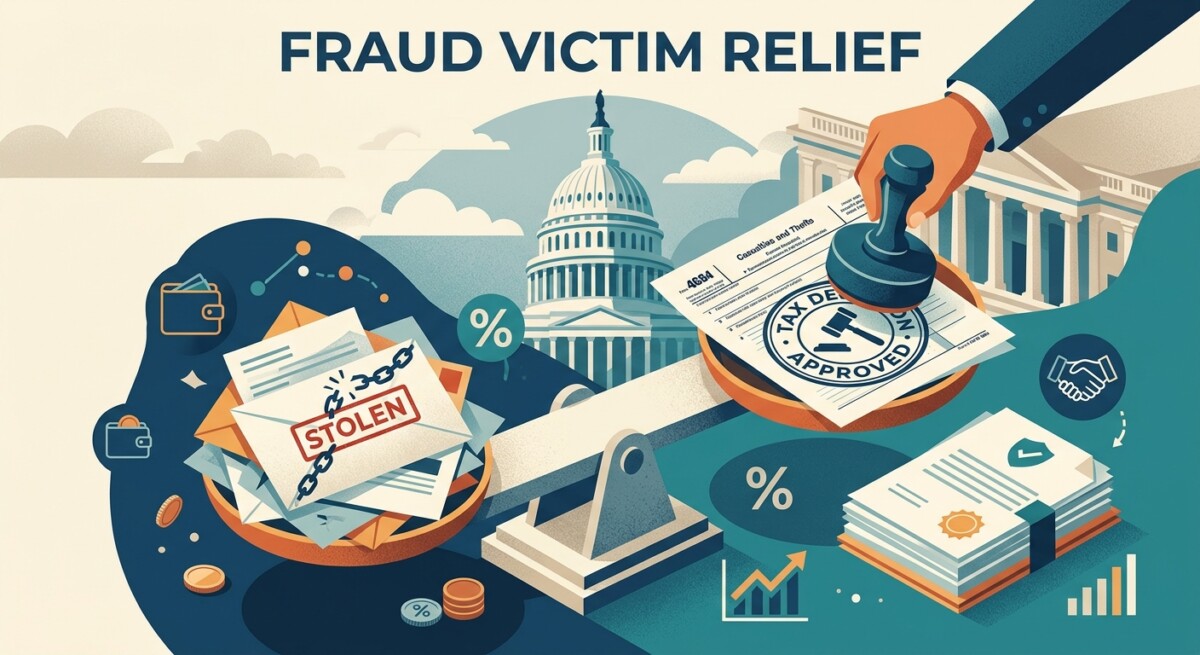
What is the fraud victims tax deduction? HR 9500
Every month in our Los Angeles practice we see the same story. A client is contacted by someone impersonating their bank, a federal agency, or a tech-support desk. By the time the client realizes it was a scam, the money is gone and the second blow is landing: under current law, almost none of it is deductible. The fraud victims tax deduction at the center of HR 9500 — the Tax Relief for Fraud Victims Act — tries to change that. The bill cleared the House on September 16, 2026 by 408 votes to 17, after passing the Ways and Means Committee on July 2. It is not law yet, but a 408-vote House margin is unusual, and the shape of a final rule is now visible enough that individuals, their CPAs, and their attorneys should start preparing for it today.
What does HR 9500 actually do? 📜
It restores a federal income-tax deduction for personal theft losses from fraud and scams, even where no federally declared disaster is involved; adds timing and refund-window relief aimed at discovery-year problems; and waives the 10 percent penalty on early retirement-account withdrawals forced by the fraud.
The text of HR 9500 — Tax Relief for Fraud Victims Act (119th Congress) and the Ways and Means Committee record make the structure clear. The headline change is the removal, for qualifying scam and fraud losses, of the TCJA-era rule that restricts personal casualty and theft losses to those attributable to a federally declared disaster. That rule — codified at §165(h)(5) — is why most individual scam victims have been unable to deduct their losses since 2018.
The bill then stacks three practical reliefs on top of the restored deduction:
- Timing election. The victim may choose to claim the loss in either the year the theft occurred or the year the theft was discovered. Internal Revenue Code §165 (losses) currently ties theft losses to the discovery year under §165(e), which does not always produce the best tax result.
- Extended refund window. The deadline for filing a refund claim tied to the deduction is extended to at least one year after the victim discovers the loss, and certain refund caps are removed. For victims who did not know they had been defrauded for several years, this preserves access to the deduction even when the ordinary §6511 refund window has closed.
- Retirement-account relief. The 10 percent additional tax under §72(t) on early withdrawals is waived where the withdrawal was induced by the fraud, and victims have one year after discovering the theft to redeposit the funds without tax consequences. That is a materially longer runway than the 60-day rollover window at §408(d)(3).
Why can’t individual fraud victims deduct their losses today? ⚖️
Because the Tax Cuts and Jobs Act of 2017 suspended personal casualty and theft losses for individuals through 2025, with a narrow carve-out only for losses attributable to a federally declared disaster.
Before TCJA, Internal Revenue Code §165 (losses) allowed an itemizing individual to claim a personal theft loss subject to the long-standing $100 per-event and 10-percent-of-AGI floors. TCJA added §165(h)(5), which turned off that deduction for tax years 2018 through 2025 except where the loss is attributable to a federally declared disaster. An FBI-documented phantom-hacker scam, a romance scam, a cryptocurrency investment scam, or a kidnapping-impersonation scam does not come with a FEMA declaration. For individual victims, the result has been near-total nondeductibility of their losses despite the losses being, under §165(e), textbook thefts.
A separate line of IRS guidance — Chief Counsel Advice 202511015 — has carved out a narrow lane for scams entered into with a profit motive, treating those losses as transactional theft losses deductible without the §165(h)(5) limitation. But that lane is narrow, fact-intensive, and does not reach the majority of personal fraud losses. HR 9500 would close the gap by statute.
The TCJA sunset is not an automatic fix
The §165(h)(5) limitation is scheduled to expire after the 2025 tax year under TCJA’s sunset calendar, which would in theory restore the pre-2018 personal casualty and theft deduction automatically for 2026. In practice, Congress has repeatedly moved TCJA sunsets, and relying on an expiration that may be extended is not a planning strategy. HR 9500 would make the restoration permanent and attach the timing, refund, and retirement reliefs that the pre-TCJA law never had.
How would the fraud victims tax deduction fit on an actual return? 🧾
The deduction would run through IRS Form 4684 (Casualties and Thefts), flow to Schedule A as an itemized deduction, and preserve the long-standing $100 per-event and 10-percent-of-AGI floors unless Congress adjusts them in a conference-committee rewrite. The paper file remains the same as it has always been under IRS Publication 547 (Casualties, Disasters, and Thefts).
Mechanically, nothing in HR 9500 reinvents the compliance infrastructure for theft losses. The forms, the computation, and the documentation burden all survive. What changes is which losses can cross the §165(h)(5) threshold at all, when they are claimed, and how long the refund window stays open. In planning terms:
| Element | Current law (post-TCJA) | Under HR 9500 (if enacted) |
|---|---|---|
| Personal theft loss from scam | Nondeductible unless attributable to a federally declared disaster. | Deductible subject to the §165 floors; no disaster requirement. |
| Year of claim | Year of discovery (§165(e)). | Year of theft or year of discovery — taxpayer’s choice. |
| Refund-claim deadline | Governed by §6511 — generally three years from filing or two from payment. | Extended to at least one year after discovery, with certain caps lifted. |
| Early-withdrawal penalty on retirement funds | Full 10% §72(t) penalty unless an enumerated exception fits. | Waived where the withdrawal was induced by fraud; one-year redeposit grace. |
| Forms | Form 4684, Schedule A, Form 5329 for retirement. | Same forms — statutory basis changes, not the filing mechanics. |
Which victims stand to benefit the most? 👥
Older individuals with meaningful IRA balances who were pressured into withdrawing and wiring funds, long-horizon romance-scam victims who exceed the §165 floors, and cryptocurrency-investment victims whose transactions have already been documented but whose losses stall at §165(h)(5).
The pattern we see most often — and the one the FBI’s Internet Crime Complaint Center has flagged in several alerts — is the ‘phantom hacker’ scheme. A tech-support impersonator gains remote access, a fake bank fraud specialist confirms the intrusion, and a fake federal official convinces the victim to move retirement money to a ‘secure’ account. The victim ends up with no money, a Form 1099-R from the IRA custodian, a 10 percent additional tax exposure, and — under current law — no theft-loss deduction. HR 9500 addresses all three of those tax lines at once.
Romance-scam and kidnapping-impersonation victims see the biggest change by percentage: today they get no deduction regardless of how clear the theft is on the facts. HR 9500 would put their losses on the same footing as any other theft loss, subject to the ordinary §165 floors and substantiation rules. Cryptocurrency-investment victims whose transactions are already recorded on chain gain a cleaner legal basis for the deduction without needing to shoehorn their facts into the profit-motive exception of CCA 202511015.
What should fraud victims and their CPAs do right now? 🛠️
Treat the current-law filing as live and the proposed-law relief as a parallel track. Build the documentation file to the standard HR 9500 would ultimately require, protect any refund windows that are still open, and plan the retirement redeposit even without the statutory grace period.
- Preserve the record now. Bank and brokerage statements, wires, forged agency letters, remote-access session logs, chat and email threads, police reports, and FBI IC3 complaint numbers. The paper file is the same under current law, the pre-TCJA law, or HR 9500 — and it is the only thing the IRS will accept at exam.
- Decide the discovery year carefully. Under current §165(e) the discovery year is fixed, but the characterization matters for a profit-motive argument under CCA 202511015 today and will matter under HR 9500’s election if the bill becomes law. Document when the theft actually happened and when it was discovered.
- Protect open refund windows. If a potentially deductible loss falls inside a still-open §6511 window, do not let that window close while waiting for Congress. File a protective claim where appropriate.
- Model the retirement redeposit. Even without statutory relief, a 60-day rollover under §408(d)(3) can still work if the funds are recovered quickly. For older cases, a private letter ruling under the IRS’s §402(c)(3) waiver authority remains available — expensive, but a known path. HR 9500 would make the ruling route unnecessary in most fraud cases.
- Coordinate with counsel. Fraud cases typically have a criminal and sometimes a civil component. The tax deduction, the restitution calculation, and any insurance recovery interact under §111 (tax benefit rule) and §1341 (claim-of-right) in later years. Pick a lead early so the file does not fragment.
From our practice: the win is in the file, not the headline
In our practice, the cases that recover the most are the ones where the file was built at the time of the theft, not reconstructed in April. Every FBI IC3 complaint number, every bank-fraud escalation form, every forged letter preserved as a PDF, every screen capture of the fake agency portal is an exhibit — for a private letter ruling today, for a §165 claim tomorrow if HR 9500 becomes law, and for whatever civil or restitution process follows. The clients who leave with a deduction are the clients whose files were ready.
What is the realistic path for HR 9500 in the Senate? 🏛️
A 408–17 House margin is unusually bipartisan and increases the odds of Senate action, but the bill will almost certainly be absorbed into a broader year-end tax package rather than moved as a stand-alone statute. Expect timing, revenue scoring, and interaction with the TCJA sunset calendar to shape the final text.
Legislation that touches both the personal casualty rules and §72(t) retirement penalties usually ends up in a broader vehicle — a year-end tax package, a technical corrections bill, or a larger retirement-savings or tax-administration package. The House margin and the Ways and Means Committee’s unanimous July 2 approval suggest the policy direction is settled. What remains contested is the dollar scoring, the effective date, and whether the restored deduction is made permanent or paired with a sunset of its own.
For CPAs, the planning posture is unchanged until the Senate acts: current law governs 2026 returns, and any provision marked ‘retroactive to tax year X’ in a final enactment will be read closely at filing time. Our office is monitoring the House Ways and Means Committee and the Senate Finance Committee’s calendar for the companion bill or the vehicle that absorbs this one.
Summary: HR 9500 Tax Relief for Fraud Victims Act
- The House passed HR 9500 on September 16, 2026 by 408 to 17; the bill is not yet law and must clear the Senate and the President.
- If enacted, personal theft losses from fraud and scams become deductible under §165 even without a federally declared disaster, reversing the TCJA-era limitation at §165(h)(5) for these cases.
- Victims may elect to claim the loss in the year of theft or the year of discovery, and the refund-claim deadline is extended to at least one year after discovery.
- The 10% early-withdrawal penalty under §72(t) is waived for fraud-induced retirement withdrawals, with a one-year redeposit grace period.
- Current law continues to apply to 2026 returns until enactment. Preserve the file, protect open refund windows, and plan the retirement redeposit now so you are ready either way.
Frequently asked questions about the fraud victims tax deduction ❓
Q. What exactly does HR 9500 change for fraud victims?
HR 9500, the Tax Relief for Fraud Victims Act, would restore a federal theft-loss deduction for individual victims of fraud and scams by lifting the current limitation that permits personal casualty and theft losses only when attributable to a federally declared disaster. It would let victims claim the loss either in the year the theft occurred or the year they discovered it, extend the refund-claim deadline tied to that deduction, waive the 10 percent additional tax on early retirement-account withdrawals forced by fraud, and give victims a year after discovery to repay those withdrawals without tax consequences.
Q. Is HR 9500 already law?
No. The House of Representatives passed HR 9500 on September 16, 2026 by a vote of 408 to 17, after the House Ways and Means Committee approved it on July 2, 2026. The bill still has to clear the Senate and be signed by the President before any of its provisions take effect. Current law — the TCJA-era limitation on personal casualty and theft losses — continues to govern individual returns until that happens.
Q. Why can’t most individual fraud victims deduct their losses today?
The Tax Cuts and Jobs Act of 2017 added §165(h)(5) to the Internal Revenue Code, suspending the personal casualty and theft loss deduction for tax years 2018 through 2025 and limiting it to losses attributable to federally declared disasters. For most individual victims of romance, imposter, phishing, or investment scams, that limitation makes the loss nondeductible even though an ordinary theft loss under §165(e) occurred.
Q. Does HR 9500 apply if the fraud involved a retirement account?
Yes. The bill waives the 10 percent additional tax under §72(t) on an early withdrawal that was induced by the fraud and gives the victim one year from the date the theft is discovered to redeposit the amount without tax consequences. That is longer than the standard 60-day rollover window and does not require a private letter ruling, which is the only route currently available in most scam cases.
Q. Can I take the fraud victims tax deduction in the year the loss occurred, or when I discovered it?
Under HR 9500, the choice would be the victim’s. Current §165(e) ties the deduction to the year the loss is discovered, which can trap taxpayers whose discovery year has a low marginal rate or whose refund window has already closed. The bill would let victims elect the earlier year — when the theft happened — if that produces a better outcome, and would extend the refund-claim deadline to at least one year after discovery.
Q. What should fraud victims do between now and a possible enactment of HR 9500?
Preserve every record — bank statements, wires, forged letters, remote-access session logs, police reports, FBI Internet Crime Complaint Center (IC3) complaint numbers — because the paper file is the same whether the current law or the proposed law governs the return. If the loss falls within an open refund-claim year under current rules, do not let that year close while waiting on legislation. If the loss is already outside the window, keep the file ready in case HR 9500 or a successor bill extends the refund deadline retroactively.
This article is general information, not tax or legal advice for your situation. Fraud and theft-loss cases turn on their facts and on whether, when and how HR 9500 is enacted. If you or a family member has been targeted by a scam, contact SW Accounting & Consulting Corp for a confidential review.