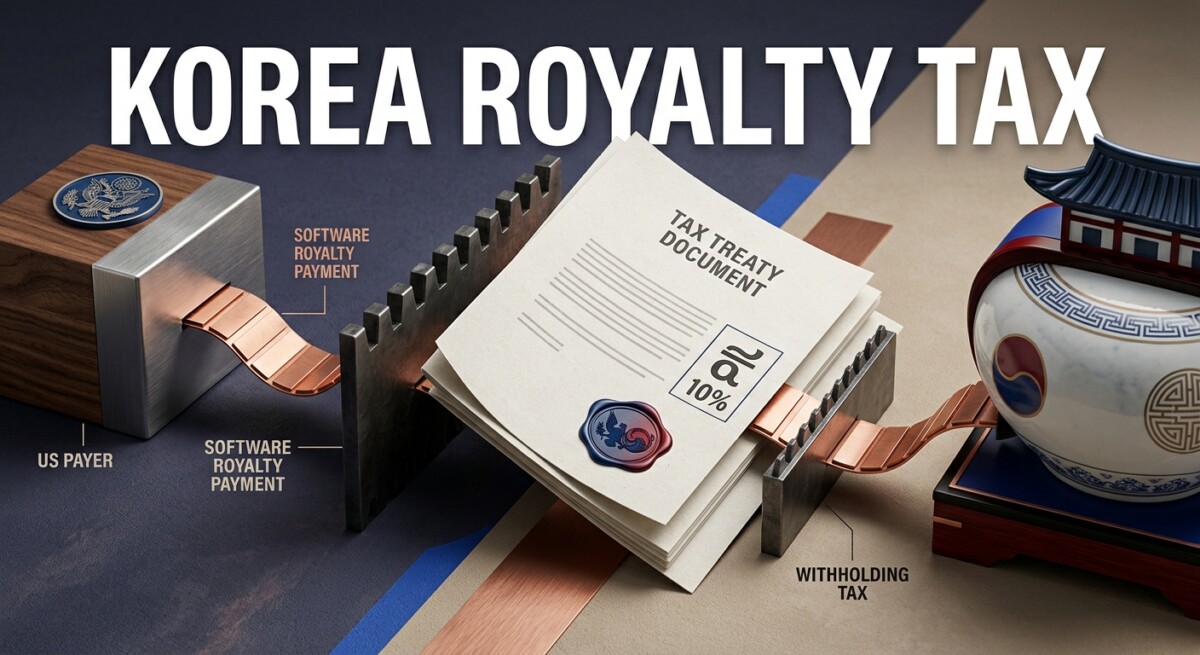
What is the US-Korea tax treaty royalty rate, and how do I claim it?
When a US company pays a Korean software vendor for a license, the US side almost always starts from the same question: do we have to withhold 30% of the gross payment and send it to the IRS? Treating a cross-border software fee as a plain vendor invoice is one of the most expensive mistakes a Korean exporter — or its US customer — can make. The Korea tax treaty royalty rules sit at the intersection of three different parts of US tax law, and ignoring any one of them turns a routine payment into either a surprise 30% haircut or a surprise IRS notice later.
In our practice, Korean technology companies that sell into the US run into this question when the first US customer sends a procurement form asking for a W-9. The answer is almost never “W-9,” and the real decision tree starts with whether the payment is a royalty at all. This guide walks through the four questions you actually need to answer before cutting the first check, with every rate and rule tied back to the primary US source — IRS, Treasury regulations, and the US-Korea income tax treaty itself.
How much does the US withhold on a cross-border royalty by default? 💵
The statutory default is 30% of the gross royalty, taken at the moment of payment, under Internal Revenue Code sections 1441 and 1442.
The US treats royalties for the use of patents, copyrights, know-how, and similar property as fixed, determinable, annual, or periodical (FDAP) income when paid to a nonresident. Under IRC § 1441 and IRC § 1442, the US payer — called the “withholding agent” — must deduct and remit 30% of the gross payment. There is no deduction for the Korean vendor’s costs; the tax is on the gross number. The withholding agent is personally liable for the tax if it fails to withhold, so the risk sits with the US payer, not the Korean recipient.
The agent then reports the payment and the tax on Form 1042 (annual return) and issues a Form 1042-S to each foreign payee by March 15 of the following year. Those forms are the record the IRS matches against the Korean company’s claim for treaty benefits.
The sourcing rule in IRC § 861(a)(4) is why 30% is even in play: a royalty for the use of property in the United States is US-source income. If the US customer uses the software inside the US, the royalty is US-source and the 30% default applies absent treaty relief.
Does the US-Korea tax treaty really drop the rate — and to what? 📘
The treaty’s royalty article caps the US rate at 10% or 15% depending on what kind of royalty is being paid, and the Korean licensor must affirmatively claim it; it is not automatic.
The governing text is the Convention Between the United States and the Republic of Korea for the Avoidance of Double Taxation (signed 1979, as amended), accessible with the Treasury Technical Explanation on the IRS tax-treaty page. The royalty article divides outbound royalties into two baskets. Payments for the use of a copyright of literary, artistic, or scientific work, including film and television material, and payments for the use of industrial, commercial, or scientific equipment, are capped at 10%. Payments for the use of a patent, trademark, design, model, plan, secret formula or process, or for information concerning industrial, commercial, or scientific experience (know-how) are capped at 15%.
For software, that split matters: a license to reproduce and distribute a copyrighted program is a copyright royalty and travels under the 10% cap, while a license that transfers underlying know-how, source-code modification rights outside the copyright list, or a trademark almost always lands in the 15% basket. The IRS maintains a plain-English summary in Publication 901, U.S. Tax Treaties, and the reduced-rate columns in IRS Tax Treaty Table 1 are the ones your withholding agent will cross-check.
The treaty cap only works if the Korean recipient is a resident of Korea under the treaty, is the beneficial owner of the royalty, and meets any applicable Limitation on Benefits article. For a Korean corporation that is actually taxed in Korea on its worldwide income and is not a mere conduit, those three tests are usually met — but they must be documented on the form, not assumed.
Is my software payment even a royalty? (Treas. Reg. §1.861-18) 🧩
Many software payments are not royalties at all under US rules — they are sales of a “copyrighted article,” which generally eliminates US withholding entirely.
Treasury Regulation § 1.861-18 is the master classification rule for cross-border software transactions. It splits every software deal into one of four categories: (1) a transfer of copyright rights, (2) a transfer of a copyrighted article, (3) the provision of services for the development or modification of a program, or (4) the provision of know-how about computer-programming techniques.
Category (1) exists only if the US buyer receives one of the enumerated copyright rights listed in the regulation: the right to make copies for distribution to the public, to prepare derivative works for public distribution, to make a public performance, or to make a public display. If the buyer gets one of those rights, the payment is a royalty, 30% default applies, and the treaty can reduce it. Category (2) covers the ordinary end-user license: the customer can install and use the software, maybe make a backup copy, but cannot reproduce it for the public or make a derivative work. That is a sale of a copyrighted article, not a royalty, and under IRC § 861 and § 862 the sourcing rules for sales usually place the income outside the US — which means no US withholding.
In practice, most SaaS subscriptions, standard shrink-wrap licenses, and typical enterprise end-user agreements are Category (2) transactions. A Korean company whose only US cash flows are standard SaaS subscriptions sold to US customers may have no US withholding exposure at all. The 30% question only becomes real when the US contract gives the US side the right to reproduce, redistribute, embed, or re-brand the software — the hallmarks of a true copyright royalty.
What forms and filings make the treaty rate actually work? 🧾
A properly completed Form W-8BEN-E delivered to the US payer before payment, combined with the payer’s Form 1042/1042-S reporting, is the complete file.
The Korean company gives the US withholding agent Form W-8BEN-E, Certificate of Status of Beneficial Owner. Part I identifies the entity and its FATCA chapter-4 status. Part III is the treaty claim: tick the box, enter “Korea,” cite the royalty article of the treaty, and state the applicable rate (10% or 15%) and the type of income (for example, “royalty for the use of a copyright”). The form is signed under penalties of perjury by someone with authority to bind the Korean entity, and it remains valid for the year signed plus three full calendar years unless information changes.
If the Korean company has not applied for a US Employer Identification Number, the W-8BEN-E can still carry the Korean business registration number as a foreign tax ID. For passive royalty payments, that is usually enough to secure the treaty rate without pulling an EIN. The W-8BEN-E instructions explain each line and the exact wording the IRS expects.
On the US side, the payer reports every royalty payment on Form 1042-S (one per income code, per payee) and files Form 1042 by March 15. Deposits of withheld tax follow the EFTPS schedule in Publication 515. If a required W-8BEN-E is missing or defective at the time of payment, the agent must withhold at 30% — and if the Korean company later wants the extra tax back, it has to file Form 1040-NR or Form 1120-F to request a refund, which is a slow and expensive path compared to getting the W-8BEN-E right up front.
How do the rates compare across common software payment types? 📊
The table below collapses the four most common Korean-to-US software fact patterns into their US tax treatment.
| Payment type | Classification under Reg. §1.861-18 | US default | Treaty-capped rate |
|---|---|---|---|
| End-user SaaS subscription or shrink-wrap license | Copyrighted article (sale) | Generally no US withholding | N/A |
| License to reproduce and distribute software to US public | Copyright right (royalty) | 30% | 10% |
| Payment for trademark, patent, or know-how embedded in software | Industrial royalty | 30% | 15% |
| Custom development or modification by Korean team | Services | Depends on where services are performed; US-performed services → ECI | N/A for royalty article |
Mixed contracts are common and need to be broken into components under Reg. §1.861-18(b)(3). A single invoice that bundles an end-user license, a bulk reproduction right, and a maintenance service has to be split, with each slice run through its own rule. The withholding agent cannot default to one rate for the whole invoice.
What does a clean year-one setup look like for a Korean software exporter? 🚀
Four moves cover almost every Korean software company’s first-year US withholding posture.
- Classify every revenue line. Walk each US customer contract through Reg. §1.861-18 and tag it as copyrighted article, copyright royalty, know-how royalty, or services. The classification is what drives everything else.
- File W-8BEN-E with every US payer before the first invoice. One signed form per payer, Part III completed with the Korea treaty citation and rate, kept on file by both sides.
- Keep the beneficial-owner story simple. If a US customer asks about Limitation on Benefits, be ready to show that the Korean entity is a resident of Korea taxed on worldwide income and is not a conduit for a non-Korea party. Clean cap tables and genuine Korean operations are the usual proof.
- Reconcile Form 1042-S each February. Compare the dollars reported by each US payer to your own invoicing records before Korean year-end closing so any 30% over-withholding is spotted while a Form 1120-F refund claim is still practical.
Key takeaways
- The Korea tax treaty royalty article caps US withholding at 10% for copyright and equipment royalties and 15% for patent, know-how, and trademark royalties.
- Standard end-user software licenses and most SaaS subscriptions are sales of a copyrighted article under Treas. Reg. §1.861-18 and usually attract no US withholding at all.
- The treaty rate is not automatic — a timely, correctly completed Form W-8BEN-E must be in the US payer’s hands before the payment runs.
- Form 1042-S is the IRS’s record of your treaty rate; reconcile it against your billing every February to catch 30% over-withholding while a refund claim is still practical.
Frequently asked questions ❓
Does a Korean company need a US EIN to claim the treaty rate on a software royalty?
Not for a passive royalty claim. Form W-8BEN-E lets a foreign entity use its foreign tax identifying number in place of a US EIN for treaty-claim purposes. If the Korean entity also has effectively connected income or needs to file Form 1120-F, an EIN becomes necessary — but a W-8BEN-E on its own for royalty withholding does not require one.
If the US customer withholds 30% even though we filed a W-8BEN-E, how do we recover the over-withholding?
The cleanest path is for the US withholding agent to adjust the under-reported treaty rate on the Form 1042-S before it is filed. If the Form 1042-S has already been issued at 30%, the Korean entity can file a Form 1120-F (for a corporation) with the IRS claiming a refund, attaching the W-8BEN-E and the Form 1042-S. The statute of limitations for refund claims is generally three years from the return due date.
Does the US-Korea treaty apply to a SaaS subscription where the US customer accesses the software from US servers?
A pure end-user SaaS subscription is almost always a sale of a copyrighted article under Treas. Reg. §1.861-18, not a royalty, so the treaty’s royalty article is not even in play. The Korean seller’s revenue is foreign-source sales income and generally outside the US withholding system entirely, provided the Korean side has no US trade or business.
What rate applies to a payment that is partly a software license and partly a trademark license?
Treasury regulation §1.861-18(b)(3) requires the agreement to be split into components, each with its own characterization. The copyright-royalty portion is capped at 10% under the treaty, the trademark portion at 15%, and any end-user access portion is treated as a sale. The W-8BEN-E and Form 1042-S should reflect the split.
Who is liable if the US payer forgets to withhold on a payment that was a royalty under US rules?
The US withholding agent is personally liable for the tax plus interest and penalties under IRC §§ 1441–1463. The IRS will pursue the US payer first, even if the Korean recipient has already reported and paid Korean tax on the full gross. That is why most US customers insist on a W-8BEN-E on file before the first payment goes out.