Does the clean fuel credit still cover my fuel in 2026?
Clean fuel producers have been waiting for the IRS to tell them exactly how the One, Big, Beautiful Bill Act changes the math. The wait ended on September 8, 2026 when IRS Notice 2026-53 took effect. The notice publishes the 2026 emissions rate table, pulls indirect land use change emissions out of the calculation for fuel produced after December 31, 2025, forbids negative emissions rates for most fuels, and limits eligible feedstocks to North American sources. For taxpayers claiming the clean fuel credit under 26 U.S.C. § 45Z, none of this is optional. If your 2025 model run included a negative value, an ILUC adjustment, or a bushel of imported soy from somewhere other than Canada or Mexico, your 2026 calculation looks different.
This post walks through what the credit is, what the One, Big, Beautiful Bill Act (Pub. L. 119-21) changed, how to apply the IRS’s transition rules if you are still on a pre-June 2026 version of the DOE’s 45ZCF-GREET model, and what producers should be doing right now to keep their § 45Z claims defensible.
What is the clean fuel credit under section 45Z? ⛽
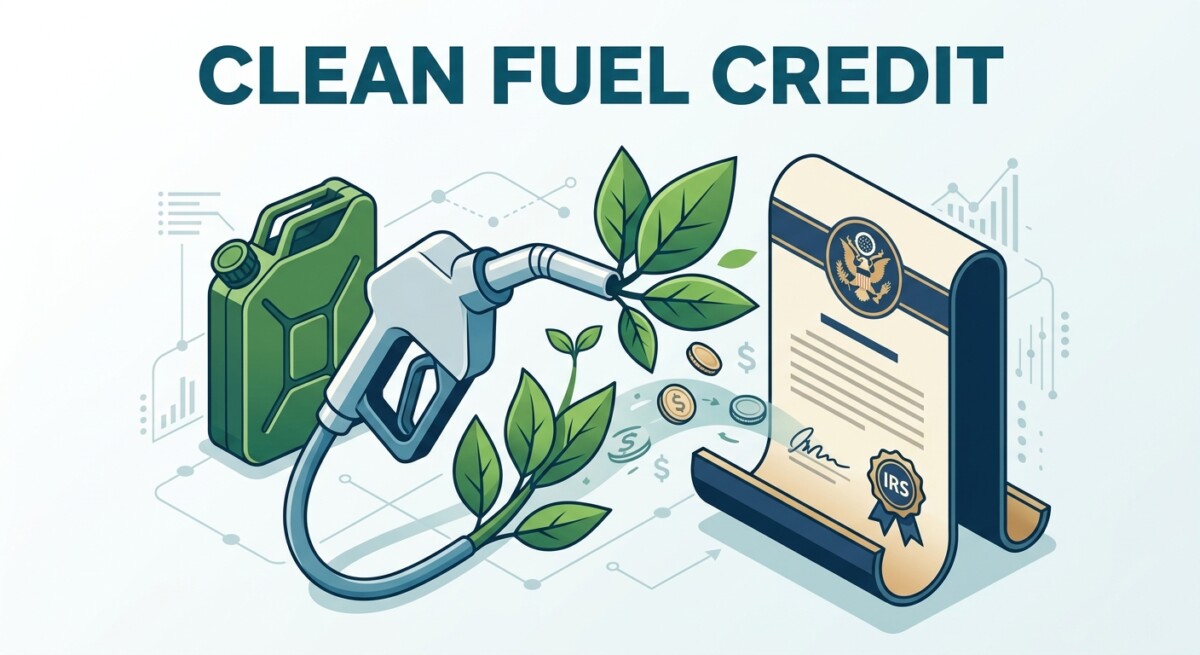
Section 45Z is an income tax credit for domestically produced clean transportation fuel. The amount per gallon is scaled by an emissions factor that measures the fuel’s lifecycle greenhouse-gas reduction against a 50 kg CO2e per mmBTU baseline.
The credit took effect for fuel produced after December 31, 2024, and runs through sales on or before December 31, 2029. To qualify, a taxpayer must produce a “transportation fuel” that meets suitability, emissions-rate, anti-coprocessing, and anti-double-crediting requirements. The emissions-rate test is the hinge: the fuel’s lifecycle emissions, expressed as kilograms of carbon dioxide equivalent per million British thermal units, must be at or below the statutory baseline. The emissions factor the producer then multiplies against the per-gallon amount is the fraction by which the fuel beats that baseline, rounded to the nearest 0.1.
Taxpayers determine a fuel’s emissions rate from the annual emissions rate table that Treasury publishes under § 45Z(b)(1)(B). If the taxpayer’s fuel type and category is not on the table, the taxpayer can petition the Secretary for a provisional emissions rate under § 45Z(b)(1)(D). The proposed regulations under § 45Z (91 F.R. 5160) flesh out how the table is set, what methodology each fuel must use, and how the whole credit calculation hangs together.
What did the OBBBA change about the clean fuel credit? 📜
The One, Big, Beautiful Bill Act added four requirements that apply only to transportation fuel produced after December 31, 2025 — ILUC exclusion, feedstock-specific emissions rates for animal manure, a floor of zero on the emissions rate for most fuels, and a North American sourcing requirement.
Section 70521 of the OBBBA rewired § 45Z in four ways. Fuel produced on or before December 31, 2025 is unaffected — the amendments reach only post-2025 production. For post-2025 production, the emissions rate must be adjusted to exclude any emissions attributed to indirect land use change. The Secretary must provide a distinct emissions rate for any fuel derived from animal manure, based on the specific manure feedstock (dairy, swine, poultry, or other). The emissions rate cannot be less than zero for any fuel other than one derived from animal manure. And the feedstock must have been produced or grown in the United States, Mexico, or Canada.
| Amendment | Section of § 45Z | Who it hits |
|---|---|---|
| ILUC excluded from emissions rate | § 45Z(b)(1)(B)(iv) | Every producer whose current model run includes an ILUC value. |
| Distinct rate for animal manure feedstocks | § 45Z(b)(1)(B)(v)(I) | RNG and biogas producers using dairy, swine, poultry, or other manure. |
| No negative emissions rates (except animal manure) | § 45Z(b)(1)(B)(v)(II), § 45Z(b)(1)(E) | Producers whose current model run returns a negative result. |
| North American feedstock sourcing only | § 45Z(f)(1)(A)(iii) | Any producer relying on imported non-Canadian/Mexican feedstock after 2025. |
The last amendment is the one most likely to change a tax position without a producer realizing it. Pre-June 2026 versions of the 45ZCF-GREET model included U.S.-sourced used cooking oil as a feedstock. The June 2026 version adds Canadian and Mexican UCO as primary feedstocks and removes imported non-Canadian/Mexican UCO from the pathways. A tolling or offtake arrangement that was eligible in 2025 may not be eligible in 2026.
How does the 2026 emissions rate table and 45ZCF-GREET model work? 🧪
Non-SAF transportation fuel uses the 45ZCF-GREET model developed by Argonne National Laboratory and designated as the successor model by Treasury. Sustainable aviation fuel uses either 45ZCF-GREET or the CORSIA methodologies. The 2026 emissions rate table in the Appendix to the notice tells producers which methodology applies to each fuel type and category.
The 2026 emissions rate table covers ethanol, biodiesel, renewable diesel, renewable natural gas, alternative natural gas (coal mine methane), propane, naphtha, hydrogen, and sustainable aviation fuel. For each type, it lists the production pathway (fermentation, transesterification, HEFA, gasification and Fischer-Tropsch, anaerobic digestion and biogas upgrading, coal mine methane capture, and so on), the primary feedstocks, and the allowed methodology. All public versions of the 45ZCF-GREET model, the user manual, FAQs, and a changelog are available at the Department of Energy 45ZCF-GREET model page.
Three pieces of the table matter the most for 2026 planning. First, dairy manure and swine manure are now listed as distinct primary feedstocks for RNG via anaerobic digestion — the two listed manures that the June 2026 version of 45ZCF-GREET covers. Poultry manure and beef manure are expected in a later 2026 update; producers of those fuels are encouraged to wait rather than file a provisional emissions rate petition that will be mooted when the model updates. Second, Canadian and Mexican UCO and Canadian and Mexican tallow are now valid primary feedstocks for biodiesel, renewable diesel, propane, and naphtha pathways. Third, hydrogen pathways run through the 45VH2-GREET model for well-to-gate emissions and then feed into 45ZCF-GREET for well-to-wheel emissions, which keeps the hydrogen and clean fuel calculations aligned.
From our practice: run both calculations for the 2025–2026 transition year
In our practice, the cleanest way to handle fuel sold across the OBBBA effective date is to generate two emissions-rate results from the model — one for fuel produced on or before December 31, 2025 (pre-OBBBA rules) and one for fuel produced after that date (ILUC excluded, zero floor, North American feedstocks only). Section 4 of the notice contemplates exactly that two-track workflow. Documenting both runs with the model version, the input parameters, and the output tables at the time of production is the evidence base that any later examination will test. The producers that will have the hardest time are the ones that captured only an aggregate number for the year.
How do I apply the transition rules if I am still on a pre-June 2026 model? 🔧
Section 4 of IRS Notice 2026-53 tells producers using a pre-June 2026 version of the 45ZCF-GREET model how to adjust those results to reflect the OBBBA amendments for fuel produced after December 31, 2025. Each amendment gets its own adjustment.
For ILUC, the taxpayer subtracts the ILUC value shown in the calculated results table from the Total LCA Results (expressed in grams of CO2e per megajoule) and then multiplies by 1.055 to convert back to kilograms of CO2e per mmBTU. For SAF determined under CORSIA Default, the taxpayer excludes the applicable Default ILUC value listed in CORSIA Default. For SAF determined under CORSIA Actual, the taxpayer excludes any ILUC value included as part of the CORSIA Actual verification process.
For foreign feedstocks, there is no adjustment: fuel produced after December 31, 2025 from a primary feedstock produced or grown outside the United States, Mexico, or Canada simply does not qualify. For fuel produced in 2025 only from imported non-Canadian/Mexican UCO, the producer must use a forthcoming version of the 45ZCF-GREET model that covers imported non-Canadian/Mexican UCO.
For negative emissions rates, the taxpayer must adjust any negative result up to zero for any 2026 transportation fuel other than fuel derived from animal manure. For fuel derived from animal manure produced on or before December 31, 2025, the producer uses a version of the 45ZCF-GREET model reflecting an alternative fate derived from the national average of all animal waste management practices. For post-2025 animal manure fuel, the producer uses a version of 45ZCF-GREET that provides the distinct, feedstock-specific emissions rates.
The June 2026 model does not pick up every OBBBA change
The June 2026 version of 45ZCF-GREET implements some, but not all, of the OBBBA amendments. Producers using that version still need to walk through the Section 4 adjustments to confirm which items are already reflected in the model output and which must be adjusted manually. A later 2026 version is expected to add poultry and beef manure as distinct feedstocks and to pick up remaining amendments; the DOE change log is the authoritative source.
What about animal manure feedstocks and farm-specific emissions rates? 🐄
Section 3.02 of the notice lets a producer calculate a farm-specific alternative fate in 45ZCF-GREET using the farm’s prior manure management practices, as of the earlier of the anaerobic digester’s commencement date or September 8, 2026. New farms (operations beginning after September 8, 2026) cannot use farm-specific rates until further guidance.
The alternative-fate framework turns on avoided emissions. The producer inputs the number of animals by type and the share of manure managed under each prior practice — uncovered lagoon, deep pit, liquid or slurry, pasture or paddock, dry lot, or solid storage — immediately before the anaerobic digester began operating (or before September 8, 2026, whichever is earlier). The model uses that pattern to compute avoided emissions and the distinct emissions rate for the fuel. For an off-farm digester, the commencement date is when the farm first began diverting manure to any off-site digester.
The substantiation requirement is strict. A producer that cannot substantiate farm-specific prior manure management practices for a given farm gets no avoided-emissions credit for that farm’s contribution to the manure inputs. The June 2026 USDA Feedstock Carbon Intensity Calculator update, and the USDA Technical Guidelines for Regenerative Agricultural Biofuel Feedstocks (91 F.R. 39334), form the backbone of what the IRS and Treasury are willing to accept as substantiation.
What should clean fuel producers do before year-end 2026? ✅
Reconcile 2026 production against the new rules, document two separate model runs for fuel produced across the OBBBA effective date, and tighten feedstock substantiation now rather than at examination.
- Pull the production ledger by month and feedstock. Flag every gallon produced after December 31, 2025 and separately track feedstocks that come from outside the United States, Mexico, or Canada. Fuel from non-North American feedstocks produced in 2026 does not qualify, no matter what the pre-OBBBA model would have returned.
- Confirm which version of 45ZCF-GREET generated the 2025 and 2026 emissions rates. Keep the output tables, input logs, and version numbers. If the version is pre-June 2026, run through the Section 4 adjustments item by item.
- Document farm-specific prior manure management practices now. The alternative-fate determination asks for the practice pattern as of a date that may already be in the past; waiting until April to collect that information turns a defensible claim into a weak one.
- Watch for 45ZCF-GREET updates covering poultry and beef manure. Producers of fuels derived from those feedstocks are explicitly encouraged by the IRS to wait for the update rather than file a provisional emissions rate petition that will be superseded.
- Coordinate with the hydrogen and SAF teams. Hydrogen pathways run through 45VH2-GREET into 45ZCF-GREET; SAF pathways can use 45ZCF-GREET or CORSIA. Pick the methodology, document it, and apply it consistently across all stages from feedstock production through distribution.
Summary: § 45Z clean fuel credit after IRS Notice 2026-53
- The clean fuel credit under § 45Z still runs through December 31, 2029 for domestically produced transportation fuel at or below the 50 kg CO2e per mmBTU baseline.
- OBBBA § 70521 reshapes the credit for fuel produced after December 31, 2025: ILUC is excluded, most negative emissions rates are prohibited, animal manure gets feedstock-specific rates, and feedstocks must come from the United States, Mexico, or Canada.
- Non-SAF fuel uses 45ZCF-GREET; SAF uses 45ZCF-GREET or CORSIA Default/Actual. The 2026 emissions rate table in the Appendix to Notice 2026-53 governs calendar year 2026 claims.
- Pre-June 2026 model users must apply Section 4 transition adjustments item by item. The June 2026 model implements some, but not all, OBBBA amendments.
- Animal manure producers can calculate farm-specific alternative fates using prior management practices as of the earlier of digester commencement or September 8, 2026 — but substantiation is required for every farm.
Frequently asked questions about the clean fuel credit ❓
Q. What is the clean fuel credit under section 45Z?
Section 45Z is a federal income tax credit for clean transportation fuel produced in the United States after December 31, 2024 and sold on or before December 31, 2029. The credit amount per gallon is multiplied by an emissions factor that measures how much lower the fuel’s lifecycle greenhouse gas emissions are than a 50 kg CO2e per mmBTU baseline. A fuel qualifies only if its emissions rate is at or below that baseline.
Q. What changed under the OBBBA that I need to know for 2026?
Section 70521 of the One, Big, Beautiful Bill Act made four amendments that apply to transportation fuel produced after December 31, 2025. The emissions rate must be adjusted to exclude indirect land use change (ILUC) emissions. Fuels from animal manure must use a distinct emissions rate based on the specific feedstock. Negative emissions rates are prohibited unless the fuel is derived from animal manure. And the feedstock must be produced or grown in the United States, Mexico, or Canada.
Q. How do I determine the emissions rate for my fuel in 2026?
Non-SAF transportation fuel uses the most recent 45ZCF-GREET model, developed by Argonne National Laboratory and designated by Treasury as the successor to the general GREET model. Sustainable aviation fuel uses either the 45ZCF-GREET model or the CORSIA Default or CORSIA Actual methodologies. The IRS publishes an annual emissions rate table — the Appendix to IRS Notice 2026-53 provides the table for calendar year 2026. If your fuel type and category is not in the table, you must file a petition for a provisional emissions rate.
Q. Does the credit cover fuel made from imported used cooking oil?
Only for fuel produced in 2025. For transportation fuel produced after December 31, 2025, the OBBBA bars the credit for any fuel derived from a feedstock that was produced or grown outside the United States, Mexico, or Canada. Used cooking oil from Mexico and Canada is now specifically included as a primary feedstock in the June 2026 version of the 45ZCF-GREET model and in the 2026 emissions rate table. Non-Canadian and non-Mexican imported UCO is out going forward.
Q. What are the recordkeeping obligations?
A taxpayer claiming the clean fuel credit must substantiate every input to the emissions rate calculation. For regenerative agricultural practices, that means documentation under the USDA technical guidelines in 7 CFR part 2100, including chain of custody standards and the audit and verification standards. For animal manure feedstocks, the taxpayer must substantiate farm-specific prior manure management practices if they are used to establish an alternative fate. The proposed regulations in 91 F.R. 5160 lay out the general substantiation framework.
Q. When is IRS Notice 2026-53 effective?
The notice is effective on and after September 8, 2026. The Appendix provides the calendar year 2026 emissions rate table. The transition rules in Section 4 of the notice tell producers who are still using a pre-June 2026 version of the 45ZCF-GREET model how to adjust results to reflect the OBBBA amendments for fuel produced after December 31, 2025.
This article is general information, not tax or legal advice for your situation. Section 45Z claims turn on the specific facts of each production run and feedstock supply chain. If you produce clean transportation fuel and want a confidential review of your 2025 and 2026 emissions rate calculations, contact SW Accounting & Consulting Corp.