
SB 253 November 10: who files in California (2026)?
For most California-connected companies above the revenue thresholds, the quiet months on climate disclosure are over. California’s Climate Corporate Data Accountability Act and its companion climate-related financial risk law have both reached the point where submissions, not comment letters, are what the California Air Resources Board is asking for. SB 253 November 10 is the date CARB has proposed as the first scope 1 and scope 2 greenhouse gas emissions deadline. This post walks through who is actually in scope, what CARB will accept for the first filing, where the SB 261 climate-related financial risk report stands after the November 2025 injunction, and the practical steps a CPA would take in the next four weeks.
Does SB 253 November 10 apply to my company? 📋
SB 253 applies to any US-formed business entity with worldwide annual revenues over $1 billion that does business in California. Non-US parents are not themselves in scope, but their US subsidiaries are if the subsidiary meets the threshold.
Both laws were enacted in 2023 and amended by Senate Bill 219 in 2024. Senate Bill 253, the Climate Corporate Data Accountability Act is codified at Health and Safety Code Section 38532 of the California Health and Safety Code. Senate Bill 261, the climate-related financial risk law, is codified at Health and Safety Code Section 38533. Both statutes direct the California Air Resources Board to adopt implementing regulations, and the current regulation approved by CARB on February 26, 2026 ties the applicability tests to California’s tax code.
Three questions decide applicability:
- Entity form. A reporting entity under SB 253 is a partnership, corporation, limited liability company, or other business entity formed under US law. A US subsidiary of a non-US parent is in scope on its own facts, regardless of where the parent is organized.
- Revenue over $1 billion. CARB’s regulation defines revenue as ‘gross receipts’ under Revenue and Taxation Code Section 25120(f)(2), which is broader than financial-statement revenue — it includes interest, dividends, and the proceeds of property sales. The threshold is tested worldwide, not just California revenue, and an entity must use the lesser of the prior two fiscal years. In practice, that means a company has to clear $1 billion two years in a row before it is in scope.
- Doing business in California. CARB imported this test from California’s tax code: an entity is doing business in California if it is organized or commercially domiciled in the state, or if California sales exceed the annually indexed threshold ($757,070 for 2025) or 25% of the entity’s total sales during the reporting year. The Franchise Tax Board publishes the indexed figure, so the test can be met by an out-of-state company with no California office that nonetheless ships into California customers.
From our practice: the parent/subsidiary analysis is where errors happen
Clients tend to look at the US parent and stop. We look at every US entity in the group that files a California return. A US subsidiary that itself clears $1 billion and does business in California is in scope on its own, even if the ultimate parent is in Seoul or Frankfurt. Conversely, a group that files on a unitary basis in California should check CARB FAQ guidance on how subsidiary revenue rolls up to the parent, because CARB has said unitary subsidiaries’ revenue counts toward the parent’s test.
Who is exempt from SB 253 or SB 261? 🏛️
The University of California is specifically exempt from SB 253. Insurance companies are fully exempt from SB 261 and are not required to report emissions under SB 253 for the 2026 cycle. CARB’s regulation adds exemptions for non-profits, government-majority-owned entities, teleworker-only California presences, and entities whose only California activity is wholesale electricity transactions.
| Exemption | SB 253 | SB 261 |
|---|---|---|
| University of California | Exempt | In scope by revenue |
| Insurance companies regulated by the California Department of Insurance | Not required to report 2026 emissions; required beginning 2027 | Fully exempt (already report under NAIC-adopted standard) |
| Non-profit or charitable organizations tax-exempt under the Internal Revenue Code | Exempt (by regulation) | Exempt (by regulation) |
| Federal, state, local government entities and entities >50% owned by government | Exempt (by regulation) | Exempt (by regulation) |
| Entities whose only California presence is teleworking employees | Exempt (by regulation) | Exempt (by regulation) |
| Entities whose only California activity is wholesale electricity transactions | Exempt (by regulation) | Exempt (by regulation) |
| Qualifying subsidiary covered by its parent’s compliant report | Exempt (by regulation) | Exempt (by regulation) |
The subsidiary exemption is important for US subsidiaries of multinational groups. CARB’s regulation defines a parent-subsidiary relationship by ownership or control of 50% or more, borrowed from the state’s Cap-and-Trade program. The subsidiary itself does not have to be in the United States, and the parent does not have to be a US entity, but the US in-scope entity must be specifically identified within the parent’s report, and CARB may require the subsidiary to notify the public docket to claim the exemption.
What does CARB expect for the first SB 253 report by November 10? 📊
CARB has proposed to defer the first SB 253 scope 1 and scope 2 reporting deadline from August 10, 2026 to November 10, 2026, and will accept whatever an entity already possessed or was already collecting on or before December 5, 2024.
On July 27, 2026, CARB released proposed modified text that would move the first scope 1 and scope 2 reporting deadline to November 10, 2026 and codify the first-year relief from its December 5, 2024 Enforcement Notice. The 15-day public comment period on those modifications closed on August 11, 2026. Before the modified regulation can take effect, CARB must submit the final package to California’s Office of Administrative Law for review and approval. Until that happens, the November 10 date remains proposed — but CARB has not re-opened the August 10 date, so the practical planning deadline is November 10.
CARB’s own guidance has been consistent on what entities can submit for the first cycle. For reports due in 2026, CARB’s corporate climate disclosures program page indicates that any of the following will satisfy the first scope 1 and scope 2 submission:
- An annual report that already includes the entity’s scope 1 and scope 2 emissions.
- Scope 1 and scope 2 information the entity already submits to another voluntary program or regulatory program (for example, EPA’s Greenhouse Gas Reporting Program or CDP).
- Scope 1 and scope 2 emissions reported using CARB’s voluntary reporting template.
- If the entity was not possessing or collecting the data on or before December 5, 2024, a signed statement on company letterhead stating that fact in reliance on CARB’s Enforcement Notice.
On September 1, 2026, CARB published additional submission materials, including a voluntary intake platform for providing fee contact information and emissions data, related submission guidance, and an instructional video. Use of the platform is optional. Entities may also submit the required information directly to CARB by email to climatedisclosure@arb.ca.gov. The reporting period for most calendar-year entities is fiscal year 2025; entities with a fiscal year ending between January 1 and February 1, 2026 report on the year ending in 2026.
Scope 3 is not due in 2026, but the safe harbor is time-limited
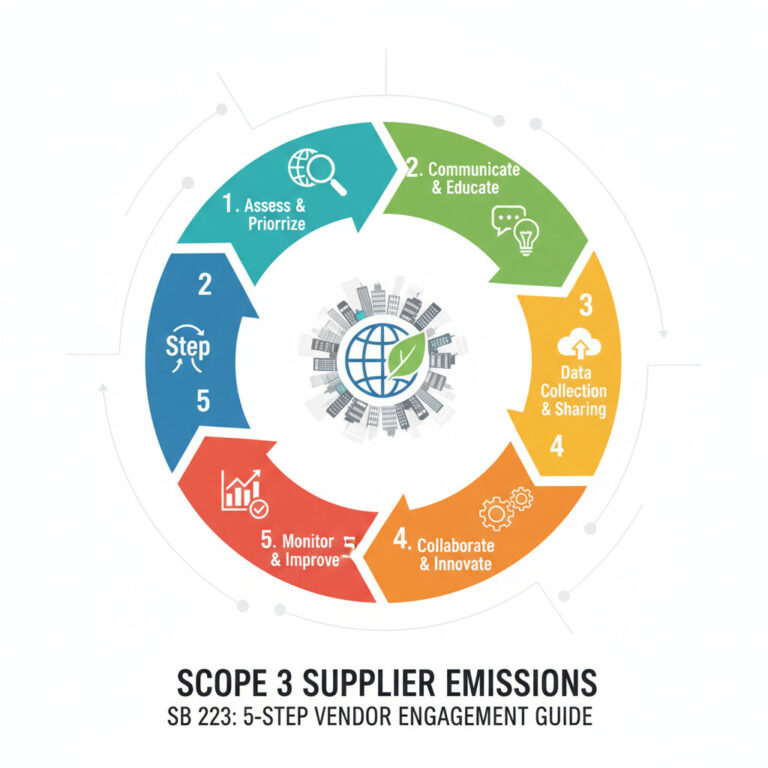
Scope 3 greenhouse gas emissions are not required for the first SB 253 cycle. When scope 3 reporting is required (CARB’s 2027-and-beyond rulemaking is separate and ongoing), the statute provides a safe harbor through 2030: scope 3 disclosures made ‘with a reasonable basis and disclosed in good faith’ are not subject to penalty, and only non-filing can be penalized before 2030. That is a time-limited cushion, not a permanent one. Any entity that will eventually report scope 3 should start the supplier-engagement work now rather than waiting for the 2027 regulation.
What is the status of SB 261 after the November 2025 injunction? ⚖️
A federal court injunction entered on November 18, 2025 halted CARB’s enforcement of SB 261’s January 1, 2026 climate-related financial risk reporting deadline. In a December 1, 2025 Enforcement Advisory, CARB confirmed it would not enforce that deadline while the appeal is pending and said it would announce an alternate date once the court resolves the matter.
SB 261, as codified at Health and Safety Code Section 38533, requires a covered entity ($500 million revenue, same ‘doing business in California’ test, same formation requirements as SB 253) to prepare a public report every two years disclosing its climate-related financial risks and the measures the entity has adopted to reduce and adapt to those risks. The report must be prepared in accordance with the Task Force on Climate-related Financial Disclosures framework, a successor, or an equivalent reporting requirement, including the IFRS Sustainability Disclosure Standards issued by the International Sustainability Standards Board.
The litigation has not killed the statute; it has suspended the first deadline. CARB’s Enforcement Advisory remains in force, oral arguments were presented on January 9, 2026, and the Ninth Circuit’s decision will determine the new reporting date. Covered entities should treat this as a scheduling delay, not a repeal. In our practice, the firms that spend the delay doing gap analysis, data gathering, and governance work are the ones that will meet the eventual deadline without an emergency; the firms that waited through the 2024 enactment, the 2025 CARB workshops, and now the injunction are the ones who will struggle.
One pragmatic point for finance teams: SB 261 allows an entity that cannot provide every disclosure to publish a report ‘to the best of its ability,’ as long as the report explains which disclosures are missing and the plan to complete them. That is a meaningful concession compared with the comparable SEC and European regimes, and it means the first SB 261 report should be published even when some pillars of the TCFD framework are not yet disclosable.
What are the penalties for not filing on time? 💸
Under SB 253, CARB may assess administrative penalties up to $500,000 per entity per year for non-filing, late filing, or other compliance failures. SB 261 caps penalties at $50,000 per entity per year. Through 2030, scope 3 penalties under SB 253 are available only for non-filing, not for a reasonable, good-faith estimate.
CARB’s December 2024 Enforcement Notice provides first-cycle discretion for SB 253: for the first scope 1 and scope 2 report, CARB will not take enforcement action against an entity that makes a good faith effort to comply with the data it already possessed or was already collecting on or before December 5, 2024. CARB staff have indicated in public workshops that an entity that has previously published scope 1 and scope 2 emissions cannot credibly claim it did not have the data. The practical takeaway: if your prior sustainability report or 10-K already discloses scope 1 and scope 2 figures, those are the numbers CARB expects to see.
The November 10 submission is not only about avoiding a monetary penalty. For many companies, the business consequences — debt covenants that reference regulatory compliance, customer contracts that require climate disclosure, and board-level attention to the control environment — are the larger exposure. A $500,000 statutory ceiling is small next to a covenant breach or a renewal-time question from a procurement team.
What should a CPA do in the next four weeks? 🗓️
Confirm applicability, locate the data already in hand on December 5, 2024, pick a submission vehicle, decide on the intake platform or email submission, and align the governance package so a signed letterhead statement or an emissions report can go out before November 10.
- Run the applicability check as of your fiscal year-end. Pull two years of worldwide gross receipts under Revenue and Taxation Code Section 25120(f)(2), check organization or commercial domicile, and compute California sales against the $757,070 or 25% test. For groups, run the test for the parent and every US subsidiary that files in California.
- Decide the subsidiary strategy. If a non-US parent will publish a compliant group report, make sure the US in-scope subsidiary is specifically identified in it, and plan the public-docket notification CARB may require.
- Inventory your December 5, 2024 data. Pull the scope 1 and scope 2 figures the entity possessed or was already collecting on that date — annual report exhibits, EPA GHGRP filings, CDP submissions, voluntary sustainability reports, utility invoices in a system of record. Document the source so a reviewer can tie the submission back to it.
- Pick the submission vehicle. Choose between (a) a prior annual or sustainability report with scope 1 and scope 2 data included, (b) a copy of your EPA or voluntary program submission, (c) CARB’s voluntary reporting template, or (d) a signed letterhead statement that you were not collecting the data on December 5, 2024.
- Choose intake platform or email. CARB’s optional intake platform (opened September 1, 2026) accepts contact information for the fee assessment plus the emissions report; alternatively, submit by email to climatedisclosure@arb.ca.gov. Decide early so the governance package can be approved on the right template.
- Align governance. Who signs the letterhead statement? Who approves the emissions report before it goes to CARB and becomes public? Who owns the SB 261 climate-risk report once an alternate deadline is announced? These are controls questions, not accounting ones, and they do not wait until the week before November 10.
Summary: SB 253 November 10 and SB 261 after the injunction
- SB 253 applies to US-formed entities with worldwide revenue over $1 billion that do business in California, measured on CARB’s regulation using Revenue and Taxation Code Section 25120(f)(2) gross receipts and the lesser of the prior two fiscal years.
- CARB has proposed to defer the first scope 1 and scope 2 reporting deadline from August 10, 2026 to November 10, 2026, with first-cycle discretion for data already possessed or collected on or before December 5, 2024.
- SB 261’s January 1, 2026 climate-related financial risk deadline is subject to a federal court injunction and CARB’s December 1, 2025 Enforcement Advisory; an alternate date will follow the Ninth Circuit’s decision.
- SB 253 penalties reach $500,000 per entity per year; SB 261 penalties are capped at $50,000; scope 3 enjoys a statutory good-faith safe harbor through 2030.
- The four-week work plan is applicability, December 5, 2024 data inventory, submission vehicle choice, intake platform or email, and governance sign-off.
Frequently asked questions about SB 253 November 10 ❓
Q. What is the current SB 253 November 10 reporting deadline?
On July 27, 2026, CARB released proposed modified text that would defer the first SB 253 scope 1 and scope 2 reporting deadline from August 10, 2026 to November 10, 2026. The public comment period closed on August 11, 2026. Until the Office of Administrative Law approves the final package, the deferral remains proposed, so entities should monitor CARB’s rulemaking page and prepare on the November 10 timeline.
Q. Who must report under SB 253?
A reporting entity is a partnership, corporation, limited liability company, or other business entity organized under US law, with total annual revenues over $1 billion, that does business in California. CARB’s February 2026 regulation defines revenue as gross receipts under California Revenue and Taxation Code Section 25120(f)(2), measured on a worldwide basis, and uses the lesser of the prior two fiscal years. The University of California is specifically exempt; non-profits, government-majority-owned entities, teleworker-only presences, and certain wholesale electricity entities are also exempt.
Q. Who must report under SB 261 and when?
A covered entity under SB 261 is defined like a reporting entity under SB 253, except the revenue threshold is $500 million. SB 261 was scheduled to require a public climate-related financial risk report by January 1, 2026, but a federal court injunction entered on November 18, 2025 halted enforcement of that deadline. CARB confirmed in its December 1, 2025 Enforcement Advisory that it will not enforce the January 1 deadline while the appeal is pending and will post an alternate date once the court resolves the matter.
Q. What does ‘doing business in California’ mean for SB 253 and SB 261?
CARB’s February 2026 regulation incorporates California’s tax definition: an entity is doing business in California if it is organized or commercially domiciled in California, or if California sales exceed the annually indexed threshold ($757,070 for 2025) or 25% of the entity’s total sales during the reporting year. The Franchise Tax Board publishes the indexed threshold each year, so the test can be met even by entities with no California office.
Q. What can I submit for the first SB 253 report?
CARB will accept the scope 1 and scope 2 emissions data an entity already possessed or was already collecting on or before December 5, 2024. Acceptable formats include an annual report that includes those numbers, data already submitted to another voluntary or regulatory program, or CARB’s voluntary reporting template. An entity that was not collecting the data on that date may submit a signed letterhead statement to that effect in reliance on CARB’s December 2024 Enforcement Notice.
Q. What are the penalties for not reporting?
Under SB 253, CARB may assess administrative penalties up to $500,000 per entity per year for non-filing, late filing, or other compliance failures. Scope 3 emissions carry a statutory safe harbor through 2030 when disclosures are made with a reasonable basis and in good faith; before 2030, scope 3 penalties are reserved for non-filing. SB 261 caps penalties at $50,000 per entity per year, and the law allows an inadequate report to proceed if the entity explains which disclosures are missing and the plan to complete them.
Q. Does a non-US parent company’s reporting cover its US subsidiary?
Yes, if the parent-subsidiary relationship meets CARB’s definition (ownership or control of 50% or more) and the US in-scope entity is specifically included within the parent’s report. The subsidiary exemption does not require a US parent, but CARB may require the subsidiary to notify the public docket to claim the exemption.
This article is general information, not tax or legal advice for your situation. Rulemaking, litigation, and CARB’s enforcement discretion are moving quickly. Verify current requirements against the California Legislature’s chaptered statutes and CARB rulemaking pages before filing. If your company is in scope, contact SW Accounting & Consulting Corp for a scoping review and a tailored compliance plan.