What is pro forma financial information? SEC Article 11
Every few months, a client preparing a Form 8-K or a registration statement calls our Los Angeles office with the same question: do we actually need pro forma statements, and if so, for what? The trigger is usually a signed acquisition agreement, a disposition that just closed, or an underwriter pushing back on an S-1 draft. The question sounds mechanical, but the answer decides how the deal gets presented to investors — and whether a filing is complete. The SEC’s requirement for pro forma financial information lives in Regulation S-X Article 11, and the rule set was reorganized in May 2020. This post explains what Article 11 actually asks for after those amendments: which transactions require pro forma, how the three adjustment categories work, which periods are presented, and where in a Form 8-K the information gets filed.
What is pro forma financial information under SEC rules? 📊
Pro forma financial information is an illustration of how a significant transaction would have affected a registrant’s historical financial statements if it had occurred earlier. The SEC’s rules for preparing and presenting it live in Regulation S-X Article 11.
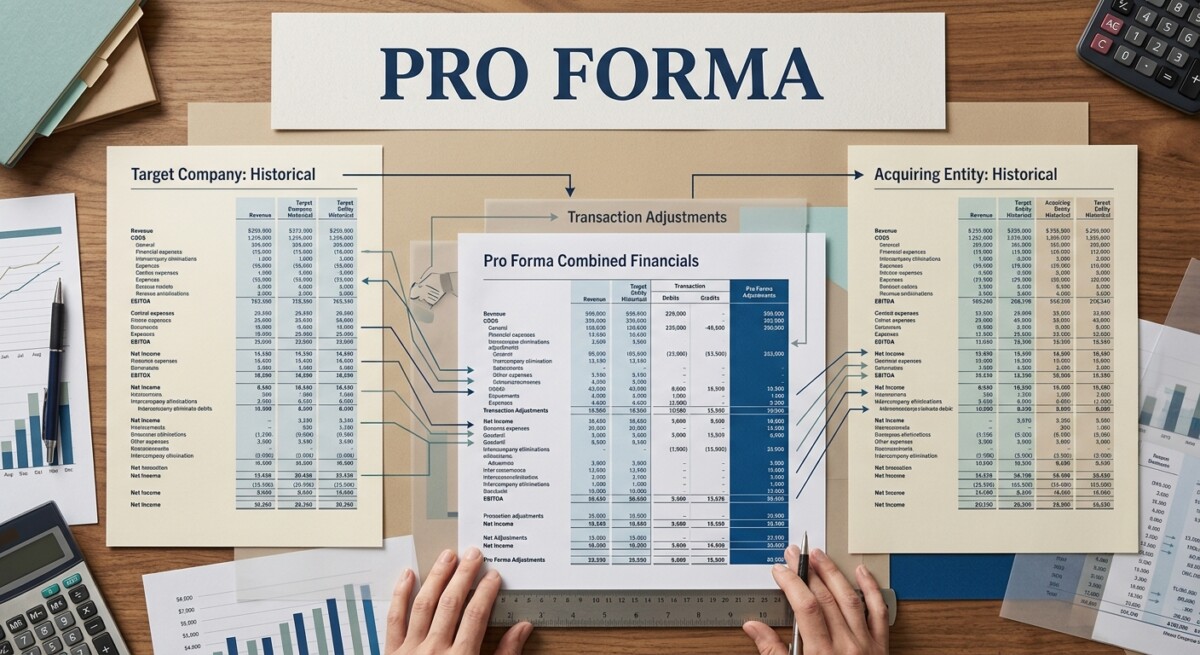
Article 11 was adopted to help investors evaluate the effect of significant transactions on a registrant’s financial position and results of operations. Pro forma statements are condensed, columnar presentations that layer transaction-related adjustments onto the historical balance sheet and income statement. They are not forecasts and they are not a substitute for audited historical statements. They are an illustration of what the historical numbers would have looked like, held to the specific preparation rules in S-X Rule 11-01 and S-X Rule 11-02.
In SEC’s May 20, 2020 announcement, the Commission adopted the current version of Article 11. SEC Release No. 33-10786 replaced the old pro forma adjustment framework and resolved a long-running practice question about where synergies and dis-synergies should sit. The release took effect for fiscal years beginning after December 31, 2020, with voluntary early compliance before that date. The structure we describe below is the post-amendment regime that applies to every current filing.
Which transactions trigger pro forma financial information? 🧾
Article 11 requires pro forma information in two situations: ‘specified’ transactions listed in the rule, and ‘other’ transactions where the pro forma illustration would be material to investors.
Specified transactions are the usual trigger. They include a consummated or probable acquisition of a significant business (including equity-method investments), a disposition or probable disposition of a significant business, a combination of entities under common control, a roll-up transaction, and a spinoff. The same thresholds apply to significant acquisitions and dispositions of real estate operations, though the significance test itself is different for real estate.
Other transactions are the catch-all. They cover situations where no specified-transaction rule applies but the pro forma illustration would be material. The Division of Corporation Finance Financial Reporting Manual and Article 11 itself list examples: an acquisition, disposition, or exchange of significant assets outside the ordinary course of business; a change in tax status (for example, from a nontaxable to a taxable structure); emergence from bankruptcy; changes in capitalization at the effectiveness or close of an IPO; receipt and use of proceeds from a securities offering or from a disposition; the repayment or restructuring of existing indebtedness; new or modified contracts that render the historical statements no longer indicative of the ongoing entity; and dividends declared after the balance sheet date.
For a consummated business acquisition, the filing path runs through Form 8-K. Item 2.01 reports the acquisition, and Item 9.01(a) and (b) carry the acquired-business financial statements and the pro forma information. Form 8-K Item 9.01 permits the financial statements and pro forma information to be filed by amendment within 71 calendar days after the original Form 8-K was due. For a registration or proxy filing, the thresholds change with the proximity of the filing to the acquisition date.
What are the significance thresholds for pro forma financial information? 📐
Significance is tested under S-X Rule 1-02(w). The threshold that triggers a pro forma filing depends on the type of filing, whether the acquisition is consummated or probable, and the days between consummation and the registration or proxy.
| Filing situation | Significance threshold | What is filed |
|---|---|---|
| Consummated acquisition reported on Form 8-K | Acquired business > 20% significant | Target financials + pro forma info under Item 9.01 |
| Consummated disposition reported on Form 8-K | Disposed business > 20% significant | Pro forma info under Item 9.01 |
| Registration or proxy filed ≤74 days after consummation | Acquisition > 50% significant | Pro forma info in the filing |
| Registration or proxy filed ≥75 days after consummation | Acquisition > 20% significant | Pro forma info in the filing |
| Probable acquisition in a registration or proxy | To-be-acquired business > 50% significant | Pro forma info in the filing |
| Individually insignificant acquisitions, in the aggregate | Aggregate > 50% significant (certain criteria) | Pro forma info in the filing |
| Significant asset acquisition or disposition (not ordinary course) | Assets > 10% of consolidated net assets | Pro forma info only if material to investors |
The thresholds are not identical to the thresholds that trigger the acquired-business audited financial statements, and real estate operations are tested under a different significance rule. The Division of Corporation Finance Financial Reporting Manual is the SEC staff’s working reference and walks through the aggregation and timing mechanics in detail. We treat significance testing as a separate workstream from the pro forma preparation itself, because missing the test often means missing the filing date.
How do the three adjustment categories work after the 2020 amendments? 🧮
Transaction accounting adjustments are required and reflect how the transaction would have been accounted for under GAAP or IFRS. Autonomous entity adjustments are required when the registrant is a newly standalone entity. Management’s adjustments are optional, forward-looking, and shown only in the notes.
The 2020 amendments collapsed the pre-amendment distinction between adjustments that were ‘directly attributable’ and ‘factually supportable’ into a cleaner framework. Three categories now do the work:
- Transaction accounting adjustments. Required. They reflect the application of US GAAP or IFRS Accounting Standards to the transaction, assuming it had occurred earlier. For a business combination, these include the purchase price allocation to acquired assets, assumed liabilities and goodwill at fair value, acquisition-agreement-specific adjustments, accounting policy alignment between acquirer and target, and the registrant’s directly related transaction costs. For a disposition, they typically reverse the carrying amount of the disposed business and reflect any related debt extinguishment.
- Autonomous entity adjustments. Required when applicable. They show the financial effect of operating as a standalone entity when the historical statements of a carved-out business do not already reflect that status — for example, allocating corporate overhead or adjusting cost structures that depended on being part of a parent.
- Management’s adjustments. Optional. They are forward-looking adjustments that illustrate expected synergies and dis-synergies. They sit in the explanatory notes, not in the columnar totals on the face of the pro forma statements, and they must meet specific disclosure criteria: a reasonable basis, both aggregate and per-share presentation where applicable, and a clear statement of the limitations of the illustration.
From our practice: where issuers get the three categories wrong
In our practice, the most common error is treating a planned cost takeout as a transaction accounting adjustment because management is confident about the number. Under the amendments, that number almost always belongs in management’s adjustments, in the notes, with the required caveats. Pushing it into the columnar totals produces a pro forma ‘Pro Forma’ column that overstates the illustrated result and, more practically, invites a comment letter. The clean sequence is to prepare the transaction accounting adjustments first against the acquisition agreement and the GAAP conclusions, decide whether autonomous entity adjustments apply at all, and only then evaluate whether management wants to add synergy disclosures in the notes.
Which periods and statements have to be presented? 📅
A condensed pro forma balance sheet as of the most recent historical balance sheet date, and a condensed pro forma income statement for the most recent fiscal year and the most recent interim period. EPS is required, and the income statement stops at income from continuing operations.
The pro forma condensed balance sheet is prepared as of the date of the most recent historical balance sheet filed or required to be filed under S-X Rule 3-01, unless the historical balance sheet already reflects the transaction. The pro forma condensed income statement is prepared for the most recent fiscal year and the most recent interim period, unless the historical income statement already reflects the transaction for the entire period. The pro forma income statement presentation stops at income or loss from continuing operations, even if the historical income statement separately reports discontinued operations.
Basic and diluted EPS, together with the related weighted-average share counts, are required on the face of the pro forma income statement. When a noncontrolling interest exists in the registrant or the acquired business, the allocation of income (or loss) from continuing operations to the controlling interest must be presented. Explanatory notes carry the detail: the purchase price components, the identification of the acquired assets and assumed liabilities at fair value, the key assumptions behind each adjustment, and any management’s adjustments elected under the 2020 amendments.
The pro forma illustration is not a forecast
Article 11 is clear that pro forma statements are not projections and are not held out as predictive. They illustrate the historical periods as if the transaction had occurred earlier. Companies that cross that line — presenting expected synergies in the columnar totals, or writing introductory language that reads as forward guidance — face SEC staff comments and, in some cases, an amendment to the filing. The explanatory-notes location of management’s adjustments is the specific guardrail the 2020 release built for this problem.
What practical steps should a registrant take before filing? ✅
Confirm the trigger, run the significance tests, align the periods, prepare the three adjustment categories in order, and reconcile the columnar totals to the historical statements before the filing is signed.
- Confirm the trigger. Classify the transaction against the Article 11 list: specified transaction, other transaction material to investors, or no pro forma required.
- Run the significance test. Apply the S-X Rule 1-02(w) tests to the business acquired or disposed of. For real estate operations, use the real estate significance test. For aggregated insignificant acquisitions, apply the aggregation rules in the Financial Reporting Manual.
- Lock the periods. Identify the most recent historical balance sheet and income statement periods required under S-X Rule 3-01. If the historical statements already reflect the transaction, the pro forma requirement for that period is dropped.
- Prepare transaction accounting adjustments first. Document the purchase price allocation, the acquisition-agreement adjustments, and the accounting policy alignment. If any allocation is preliminary, say so and explain how it may change.
- Evaluate autonomous entity status. If the registrant was carved out of a parent, determine whether autonomous entity adjustments are required and prepare them to reflect standalone operations during the historical periods.
- Decide whether to include management’s adjustments. If so, meet the disclosure criteria, keep them in the notes, and label the forward-looking nature of the information.
- Reconcile to the filing. Tie the pro forma columns to the historical statements, verify EPS and share counts, and confirm the Item 9.01 (or registration-statement) placement is correct. For a Form 8-K, calendar the 71-day amendment window if the information is filed later.
Summary: SEC pro forma financial information under Article 11
- Article 11 requires pro forma information for specified transactions (significant acquisitions, dispositions, common-control combinations, roll-ups, spinoffs) and for other transactions where the illustration would be material to investors.
- The 2020 amendments in SEC Release No. 33-10786 reorganized the rules around three adjustment categories: transaction accounting (required), autonomous entity (required when applicable), and management’s adjustments (optional, in the notes).
- Significance is tested under S-X Rule 1-02(w). Common thresholds: >20% on Form 8-K; >50% within 74 days of consummation in a registration or proxy; back to >20% after 74 days.
- Presentation: condensed balance sheet at the most recent historical date, condensed income statement for the most recent fiscal year and interim period, income from continuing operations only, with basic and diluted EPS.
- Form 8-K Item 9.01 allows the pro forma information to be filed by amendment within 71 calendar days after the original Form 8-K was due.
Frequently asked questions about pro forma financial information ❓
Q. When does a company have to file pro forma financial information with the SEC?
Regulation S-X Article 11 requires pro forma financial information in two situations. First, for ‘specified’ transactions that have been consummated or, in limited cases, are probable — a significant business acquisition or disposition, a combination of entities under common control, a roll-up transaction, or a spinoff. Second, for ‘other’ transactions where pro forma information would be material to investors, such as an acquisition of significant assets outside the ordinary course, a change in tax status, emergence from bankruptcy, a change in capitalization at an IPO, or a significant debt restructuring. The requirement attaches to Form 8-K, registration statements, and proxy statements, not every filing.
Q. What are the three categories of pro forma adjustments under the 2020 amendments?
SEC Release No. 33-10786 (May 2020) replaced the old pro forma adjustment framework with three categories. Transaction accounting adjustments reflect the required accounting for the transaction under US GAAP or IFRS, assuming the transaction had occurred earlier. Autonomous entity adjustments apply when the registrant was previously part of another entity and reflect how the standalone entity would have operated during the historical periods. Management’s adjustments are optional, forward-looking illustrations of expected synergies or dis-synergies; they must meet specific disclosure criteria and are presented in the explanatory notes, not in the columnar totals.
Q. What is the significance threshold that triggers pro forma reporting for a business acquisition?
For a consummated business acquisition reported on Form 8-K, pro forma information is required when the acquired business exceeds 20% significance under the S-X Rule 1-02(w) tests (investment, asset, or income). For an acquisition disclosed in a registration or proxy statement effective within 74 days of consummation, the threshold is 50%; after 74 days, it drops back to 20%. Probable acquisitions trigger pro forma information when they exceed 50% significance. Individually insignificant acquisitions must be aggregated and tested as a group against the 50% threshold.
Q. How many periods of pro forma financial statements have to be presented?
Generally, a condensed pro forma balance sheet is presented as of the most recent historical balance sheet date filed or required under S-X Rule 3-01, unless the transaction is already reflected there. A condensed pro forma income statement is presented for the most recent fiscal year and the most recent interim period. The pro forma income statement stops at income from continuing operations, even if the historical income statement separately presents discontinued operations. If a noncontrolling interest exists, the allocation of pro forma income to the controlling interest must be shown. EPS, basic and diluted, is required on the pro forma income statement.
Q. Where in Form 8-K does pro forma financial information actually get filed?
A consummated business acquisition is reported under Item 2.01 of Form 8-K, and the financial statements of the acquired business plus the pro forma financial information are filed under Item 9.01(a) and 9.01(b). Form 8-K Item 9.01 allows the pro forma information to be filed by amendment within 71 calendar days after the initial Form 8-K is due. Significant asset acquisitions and dispositions that are not in the ordinary course of business — using the 10% of consolidated net assets threshold — are also reported on Form 8-K, but pro forma information is required only if it would be material to investors.
Q. Can management’s expected synergies be shown on the face of the pro forma statements?
No. Under the 2020 amendments, synergies and dis-synergies are management’s adjustments and are presented in the explanatory notes, not as columns on the pro forma balance sheet or income statement. They are optional, and when presented they must have a reasonable basis, be disclosed in both aggregate and per-share terms where applicable, and be accompanied by a statement of their forward-looking nature and the material limitations of the illustration. The columnar totals on the pro forma statements include historical balances plus transaction accounting adjustments and, when applicable, autonomous entity adjustments — nothing else.
This article is general information, not accounting or legal advice for your situation. Pro forma preparation depends on the facts of the transaction and the filing. If you are planning a significant acquisition, disposition, carve-out, or IPO and need help with the Article 11 analysis, contact SW Accounting & Consulting Corp for a confidential review.