State tax developments: CA AMT, Iowa, NC, Illinois
What changed this week
| Development | Who it affects |
|---|---|
| California research credit may offset state corporate AMT (pending precedential opinion) | California corporations that have accrued research credits under Revenue and Taxation Code section 23609 and have been limited by the state corporate alternative minimum tax in any open year. |
| Iowa voters approve supermajority rule on income tax increases | Businesses headquartered or expanding in Iowa, multistate companies modeling long-run Iowa state income tax exposure, and residents weighing Iowa as a work-from-anywhere base. |
| North Carolina voters cap individual and corporate income tax at 3.5 percent | Businesses already operating in North Carolina, companies evaluating North Carolina for new operations or expansions, and multistate employers modeling long-run effective state tax rates. |
| Illinois Targeted Advertising Services Tax — draft rules out for comment through November 30 | Advertising technology platforms, media agencies, and in-house advertising operations that serve targeted advertising to users in Illinois, plus businesses that buy advertising services from in-scope providers and should expect contracts to reset. |
California research credit may offset state corporate AMT (pending precedential opinion)
The California Office of Tax Appeals posted a pending precedential opinion, 2026-OTA-532P, holding that a California-headquartered company’s California research credit under Revenue and Taxation Code section 23609 may be used to offset its California corporate alternative minimum tax liability. The OTA declined the Franchise Tax Board’s request to overrule a 2010 State Board of Equalization decision (2010-SBE-001) that read the definition of tax in Revenue and Taxation Code section 23036(d)(1) to permit the enterprise zone hiring credit and the manufacturers’ investment credit to offset AMT. The OTA found the legislative history consistent with that interpretation and noted that the California Legislature has amended section 23036(d)(1) on eight occasions since 2010 without passing contrary language. Comments on precedential designation are due to the OTA by December 2, 2026.
Who it affects: California corporations that have accrued research credits under Revenue and Taxation Code section 23609 and have been limited by the state corporate alternative minimum tax in any open year.
What to do
Pull your California R&D credit carryforward schedule and identify open years in which AMT limited the credit. For material amounts, consider filing a protective refund claim before the statute of limitations closes on the earliest open year so the position is preserved if precedential status is confirmed. If the holding helps your group, submit a comment to the OTA by December 2, 2026 supporting precedential designation.
Primary source: California OTA — Opinions
Iowa voters approve supermajority rule on income tax increases
In the November 3, 2026 general election, Iowa voters approved Amendment 1 (Senate Joint Resolution 11). Once certified by the Secretary of State, Iowa’s constitution will require a two-thirds vote of each chamber of the General Assembly to pass any bill that raises the individual income tax rate, the corporate income tax rate, or the rate of any other tax based upon income or legal and special reserves. The amendment also applies to any bill that establishes a new tax on income or legal and special reserves. The amendment requires the General Assembly to enact implementing legislation.
Who it affects: Businesses headquartered or expanding in Iowa, multistate companies modeling long-run Iowa state income tax exposure, and residents weighing Iowa as a work-from-anywhere base.
What to do
Factor the two-thirds vote requirement into multi-year Iowa income tax projections — future rate increases are now materially harder to enact. Revisit expansion, hiring, and real estate decisions that have been held up by expected rate volatility. Monitor implementing legislation for any carve-outs on how the two-thirds rule applies to temporary surcharges or inflation adjustments.
Primary source: Iowa Legislature — SJR 11 Bill Book
North Carolina voters cap individual and corporate income tax at 3.5 percent
In the November 3, 2026 general election, North Carolina voters approved Amendment 2, which pairs with Senate Bill 1080 signed by the Governor on May 21, 2026. Once certified, the North Carolina constitution caps individual and corporate income tax rates at 3.5 percent, replacing the prior 7 percent constitutional ceiling. The amendment is self-executing and does not require implementing legislation to take effect.
Who it affects: Businesses already operating in North Carolina, companies evaluating North Carolina for new operations or expansions, and multistate employers modeling long-run effective state tax rates.
What to do
Re-run your North Carolina effective-rate forecast under the lower 3.5 percent ceiling. If you have been deferring North Carolina apportionment planning or site-selection decisions, revisit them now that the upper bound on North Carolina exposure is halved. For groups with mobile workforces, update state tax provision models to reflect the capped ceiling in long-run assumptions.
Primary source: North Carolina General Assembly — S.B. 1080
Illinois Targeted Advertising Services Tax — draft rules out for comment through November 30
The Illinois Department of Revenue posted draft proposed rules on October 30, 2026 to implement the Targeted Advertising Services Tax, a 10 percent tax on gross receipts from providers of targeted advertising services provided in Illinois, enacted as part of Public Act 104-0468 (Senate Bill 3019). The 10 percent tax takes effect on January 1, 2027. The draft rules include relevant definitions, illustrative examples, and underlying sourcing rules that determine when a targeted advertising service is provided in Illinois. Comments on the draft are due by November 30, 2026.
Who it affects: Advertising technology platforms, media agencies, and in-house advertising operations that serve targeted advertising to users in Illinois, plus businesses that buy advertising services from in-scope providers and should expect contracts to reset.
What to do
Pull the draft rules, map your Illinois ad spend or Illinois ad revenue under the proposed sourcing definitions, and file written comments with the Department of Revenue by November 30, 2026 if the sourcing rules do not match how your systems track customer location. Plan invoicing changes effective January 1, 2027 so the tax flows correctly on first-quarter billings, and update advertising buyer contracts to address pass-through treatment.
Primary source: Illinois Department of Revenue — Legal Information
What this means for your business
- California corporations with unused R&D credit carryforwards blocked by state AMT should pull their schedules and consider protective refund claims; the OTA reading of section 23036(d)(1) permits the section 23609 credit to offset AMT.
- Iowa’s new two-thirds vote requirement removes most of the near-term legislative risk of an income-tax rate increase — a planning assumption that was previously conservative is now anchored in the state constitution.
- North Carolina’s 3.5 percent constitutional cap halves the upper bound on North Carolina income tax exposure and tightens site-selection economics for businesses considering expansion into the state.
- The Illinois Targeted Advertising Services Tax begins January 1, 2027 — comment on sourcing by November 30 if the draft rules miss how your invoicing works, and build the January 1 cutover into your billing systems now.
This week in state tax, one paragraph
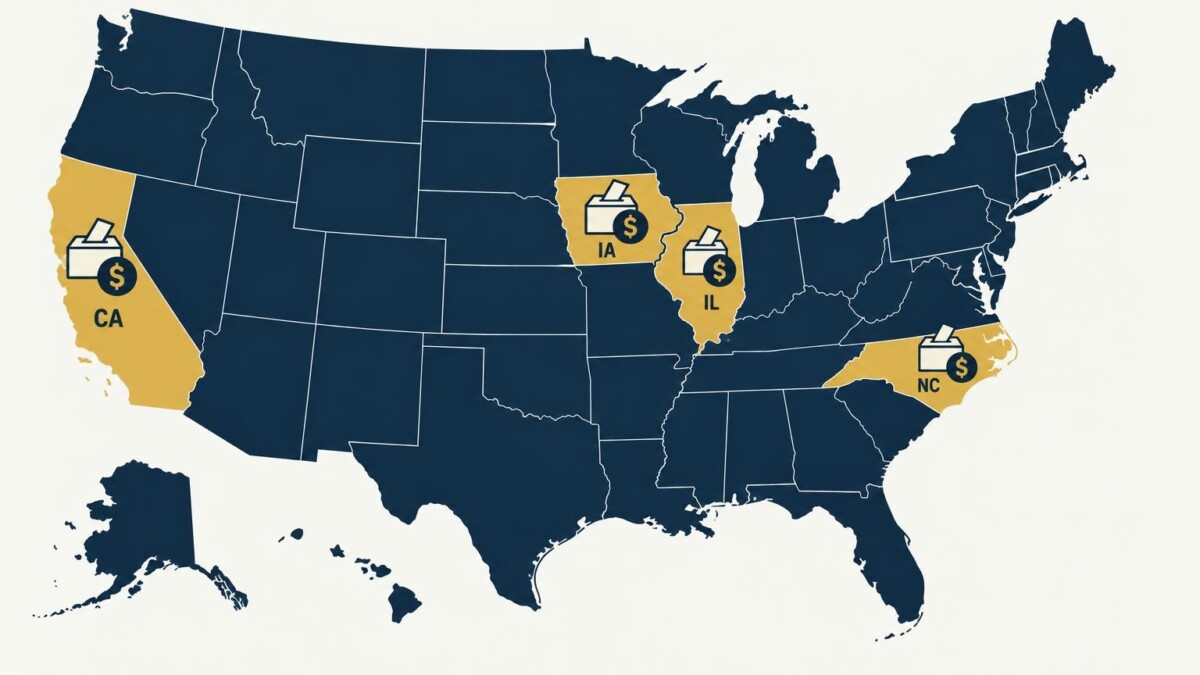
Four states moved in four different directions: California’s OTA signaled that research credits survive the corporate AMT limitation, Iowa voters locked in a two-thirds vote requirement for income tax hikes, North Carolina voters cut the constitutional income tax ceiling in half to 3.5 percent, and Illinois posted draft rules for a new 10 percent targeted advertising services tax effective January 1, 2027.
Frequently asked questions
Q. Does the California OTA opinion already change my California tax return?
Not yet. The OTA posted the opinion as pending precedential, with comments on precedential designation due December 2, 2026. Until the OTA finalizes precedential status, the opinion is persuasive but not controlling, and the Franchise Tax Board is not required to apply it to other taxpayers. Many California corporations in similar positions file a protective refund claim for open years based on the opinion’s reasoning, then pursue the claim once precedential status is confirmed. The statute of limitations continues to run in the meantime, so the timing of a protective claim matters.
Q. When do Iowa’s and North Carolina’s constitutional amendments take effect?
Both amendments were unofficially approved by voters on November 3, 2026. They take effect once the state Secretary of State certifies the official election results, which in both states occurs in the weeks after election day. The Iowa amendment requires the General Assembly to enact implementing legislation to operationalize the two-thirds vote rule. The North Carolina rate cap is self-executing and does not depend on implementing legislation, so it applies to any income tax rate change considered under the newly ratified constitution.
Q. Who actually owes the Illinois Targeted Advertising Services Tax?
The 10 percent tax is imposed on providers of targeted advertising services provided in Illinois. Buyers of advertising are not themselves liable for the tax, but they should expect providers to pass the tax through in contracts and invoices starting January 1, 2027. The scope of what counts as a targeted advertising service and the sourcing rule that determines when a service is provided in Illinois are both set in the draft proposed rules the Department of Revenue posted on October 30, 2026. Pending litigation challenges aspects of the enacting legislation.