International tax developments: October 2026 roundup
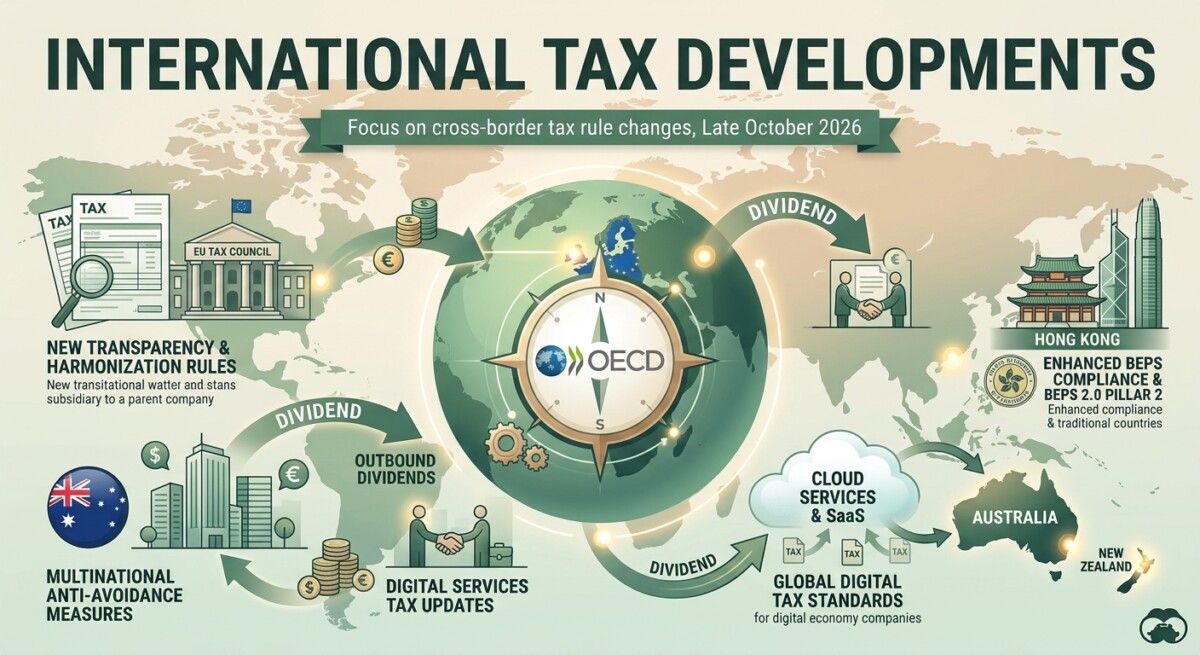
What changed this week
| Development | Who it affects |
|---|---|
| EU: Court of Justice broadens the Parent-Subsidiary anti-abuse rule | U.S. multinationals that route European subsidiary dividends through an EU holding company, private equity structures with layered holdcos, and family offices with European holding vehicles. |
| New Zealand: Inland Revenue draft reclassifies software payments to non-residents | U.S. SaaS, PaaS, and IaaS companies with New Zealand customers; New Zealand distributors of U.S. software; cross-border licensing arms. |
| Hong Kong: 5% preferential profits tax regime for strategic sectors | U.S. companies setting up or expanding a Hong Kong HQ, supply chain hub, or R&D operation; family offices and asset managers evaluating Hong Kong as a holding or treasury center. |
| OECD: 2026 peer review on country-by-country reporting released | U.S. multinational enterprise groups with consolidated revenue of approximately $850 million (EUR 750 million) or more; parent entities responsible for CbC filing; CFOs and tax directors coordinating CbC data to foreign tax authorities. |
| Australia: Treasury consults on CARF and CRS 2.0 draft legislation | U.S. crypto exchanges, custodial wallets, and payment processors with Australian customers; multinational financial institutions with Australian operations handling CRS reporting. |
EU: Court of Justice broadens the Parent-Subsidiary anti-abuse rule
On October 15, 2026, the Court of Justice of the European Union ruled in Case C-203/25 (NEO GROUP) that the general anti-abuse provision in the Parent-Subsidiary Directive can apply even when the direct EU parent carries on genuine economic activity, is the beneficial owner of the dividends, and is not a conduit company. The Court held that the provision is not limited to classic conduit arrangements. Member state tax authorities may look at the entire chain of transactions, including share transfers, loans, and assignments of receivables involving entities outside the direct parent, and may deny the dividend withholding tax exemption when the overall arrangement is not genuine. The judgment answers a preliminary reference from Lithuania’s Tax Disputes Commission and clarifies how the directive interacts with the 2019 Danish beneficial owner cases.
Who it affects: U.S. multinationals that route European subsidiary dividends through an EU holding company, private equity structures with layered holdcos, and family offices with European holding vehicles.
What to do
Pull every holding structure that relies on the Parent-Subsidiary Directive for 0% withholding tax and document the economic substance at every tier, not just the direct parent. Keep contemporaneous files on the business purpose of each loan, assignment, and share transfer in the chain. Expect EU member state tax authorities to lean harder on the whole-arrangement test when they review dividend WHT exemption claims.
Primary source: Court of Justice of the European Union, Case C-203/25 docket
New Zealand: Inland Revenue draft reclassifies software payments to non-residents
On September 2, 2026, Inland Revenue released draft interpretation guideline PUB00266 on how payments made by New Zealand businesses to non-resident software suppliers are classified for income tax and withholding tax, with consultation open until October 31, 2026. The draft replaces the 2003 IG0007 guideline. It adopts a transactional approach that looks at the legal rights and obligations each payment creates rather than contract labels: SaaS, PaaS, and IaaS are generally treated as business income from services (not royalties), while payments involving a license of copyright or know-how may remain subject to New Zealand’s non-resident withholding tax. Mixed arrangements take the dominant classification when one component is ancillary, or must be apportioned on a reasonable basis when both are material. The guideline also discusses how double tax agreements change the New Zealand analysis.
Who it affects: U.S. SaaS, PaaS, and IaaS companies with New Zealand customers; New Zealand distributors of U.S. software; cross-border licensing arms.
What to do
Review each New Zealand revenue line and the related inter-company or customer agreement, mark each as service income or royalty-bearing, and reprice withholding tax exposure under the current U.S.-NZ income tax treaty. Submit comments to Inland Revenue by October 31, 2026, if your contract types are not well covered. For large contracts that mix a service and a copyright right, document the apportionment basis in writing before the final guideline lands.
Primary source: Inland Revenue New Zealand, draft interpretation guideline PUB00266 (consultation)
Hong Kong: 5% preferential profits tax regime for strategic sectors
The 2026 Policy Address, delivered on September 16, 2026, announced a preferential policy package that includes a concessionary profits tax regime for qualifying enterprises in five strategic sectors: advanced manufacturing, R&D in innovation and technology, headquarters activities, logistics and supply chain management, and finance. Approved companies would pay profits tax at 5%, or roughly half the standard 8.25% corporate rate on the first HK$2 million and 16.5% above that, for up to five years with possible renewal. Awards are discretionary, driven by a Steering Committee on Preferential Policies chaired by the Financial Secretary, and conditioned on operating costs, full-time employees in Hong Kong, and a substantive investment plan. An amendment bill is expected to be tabled at LegCo in December 2026, with implementation targeted for the 2027/28 year of assessment.
Who it affects: U.S. companies setting up or expanding a Hong Kong HQ, supply chain hub, or R&D operation; family offices and asset managers evaluating Hong Kong as a holding or treasury center.
What to do
If you are planning an Asia-Pacific headquarters, R&D center, or logistics hub, read the Policy Address and the LegCo briefing paper for the detailed eligibility conditions. Line up a substantive hiring and investment plan in Hong Kong, since awards are case-by-case rather than automatic. Build the 2027/28 effective date into any Asia headquartering timeline that is now in planning.
Primary source: Hong Kong Chief Executive’s 2026 Policy Address
OECD: 2026 peer review on country-by-country reporting released
On October 19, 2026, the OECD published the ninth annual compilation of peer reviews of the BEPS Action 13 minimum standard on country-by-country reporting. The report covers 142 members of the OECD/G20 Inclusive Framework on BEPS and reviews each jurisdiction’s domestic legal and administrative framework, the framework for exchanging CbC reports, and measures to protect confidentiality and ensure appropriate use. The review finds that more than 120 jurisdictions now have CbC filing obligations in domestic law, that more than 5,100 bilateral exchange relationships are in place (up from about 4,900 last year), and that implementation is largely consistent with the minimum standard where legislation exists. The next peer review is scheduled for the third quarter of 2027.
Who it affects: U.S. multinational enterprise groups with consolidated revenue of approximately $850 million (EUR 750 million) or more; parent entities responsible for CbC filing; CFOs and tax directors coordinating CbC data to foreign tax authorities.
What to do
Confirm the parent-filing jurisdiction and the local-filing fallbacks for each country where you operate, especially where the peer review flags gaps in a jurisdiction’s framework. Review how the exchange network has grown this year to decide whether local filing in a given country is still required, and align the next CbC data cycle with the standards the review names.
Primary source: OECD, 2026 peer review on BEPS Action 13 country-by-country reporting
Australia: Treasury consults on CARF and CRS 2.0 draft legislation
On October 15, 2026, the Australian Treasury released draft legislation implementing the OECD Crypto-Asset Reporting Framework (CARF), a domestic crypto-asset reporting regime for Australian-resident transactions, and amendments to the existing Common Reporting Standard. The draft would require virtual asset service providers to collect customer due diligence information and report transaction details of Australian-resident users to the Commissioner of Taxation, with international CARF information exchanges beginning in 2028 and domestic reporting proposed to start July 2027. The Common Reporting Standard changes bring e-money products and central bank digital currencies into scope and tighten due diligence. Consultation is open until October 28, 2026.
Who it affects: U.S. crypto exchanges, custodial wallets, and payment processors with Australian customers; multinational financial institutions with Australian operations handling CRS reporting.
What to do
If your platform serves Australian residents or holds Australian financial accounts, map every customer flow against the draft’s definitions of in-scope service providers and reportable transactions. Submit written comments by October 28, 2026, where the draft’s scope or timing creates duplication with CARF obligations in other jurisdictions. Scope the 2027 domestic reporting build and the 2028 international exchange cycle into your technology roadmap.
Primary source: Australian Treasury consultation: Crypto asset tax transparency – draft legislation
What this means for your business
- The EU Court of Justice has widened the Parent-Subsidiary Directive anti-abuse rule beyond conduit cases. Expect member states to look at the full ownership chain and the arrangement around a dividend, not just the direct recipient.
- New Zealand is formally positioning SaaS, PaaS, and IaaS payments as service income rather than royalties for income tax, but copyright-bearing payments remain royalty-taxed. Contract wording and apportionment documentation matter more than ever.
- Hong Kong’s 5% preferential profits tax regime, tabled at LegCo in December 2026 for 2027/28, is a case-by-case award. Preparing a substantive hiring and investment plan now is the only way to be ready when applications open.
- The OECD’s 2026 CbC peer review raises the bar for exchange relationships to more than 5,100 and reinforces that multinationals with EUR 750 million revenue should expect fewer local-filing fallbacks.
- Australia’s CARF and CRS 2.0 draft is on a short consultation runway (deadline October 28, 2026). Crypto platforms with any Australian footprint should budget for a 2027 domestic reporting build.
This week in international tax, one line
EU dividend structures tighten, New Zealand reclassifies SaaS payments, Hong Kong opens a 5% rate for strategic sectors, and crypto reporting walks closer to a global standard.
Frequently asked questions
Q. I’m a U.S. company with a European holding structure. Does the C-203/25 ruling change my withholding tax position?
If your EU holding company itself has real activity and is the beneficial owner of dividends, you still have a case for the Parent-Subsidiary exemption. But the ruling says that is no longer enough on its own. The whole arrangement, including upstream and downstream loans, assignments, and share transfers, has to be genuine. Document the business purpose at every tier.
Q. My SaaS platform charges New Zealand customers. Do I need to withhold under the new draft guideline?
If the service is a pure cloud subscription with no transfer of copyright or know-how, Inland Revenue’s draft positions it as business income from services, which generally does not attract New Zealand non-resident withholding tax. If the deal includes a license to copy, modify, or sublicense the software, that component is a royalty subject to withholding, subject to the U.S.-NZ income tax treaty rate.
Q. How does Hong Kong’s new 5% rate compare to current regimes we might already use?
The regime complements, rather than replaces, existing concessions (such as the family office regime and ship-leasing rules). It is case-by-case and discretionary, so it is best used by companies that will make a real Hong Kong investment in one of the five strategic sectors and can commit to local employee counts and operating costs.
Q. We are a U.S. multinational over the CbC threshold. What should we do with the OECD 2026 peer review?
Use the review to confirm each country’s filing framework and exchange relationships. In jurisdictions the review highlights for gaps, assume local filing may still be required even if the primary filing is in the U.S. Keep the CbC data pipeline on the Action 13 schema the review reinforces.