What is a safe intercompany loan rate from Korea? (2026)
You’ve already stood up a Delaware or California entity. Payroll runs, AWS invoices come in, and the US ledger is bleeding runway while the Korean parent sits on cash that could cover the next twelve months. The practical answer is a loan from Seoul to the US sub. The hard part — the part that gets questioned on exam — is what interest rate makes the loan “arm’s length,” what paperwork survives an IRS audit, and which other Code sections then limit how much of that interest is deductible on the US return.
This piece is written for Korean parent companies and Korean-American founders whose US entity is going to borrow from a related Korean party in 2026. We walk through the intercompany loan rate safe harbor under Treasury Regulation Section 1.482-2(a), the Form 5472 disclosure that comes with it, and the three downstream rules — Sections 163(j), 267(a)(3), and 267A — that quietly reduce the deductible interest after the fact. The point is to settle the rate once, document it once, and never have to reprice.
What is the intercompany loan rate safe harbor under Section 482? 📘
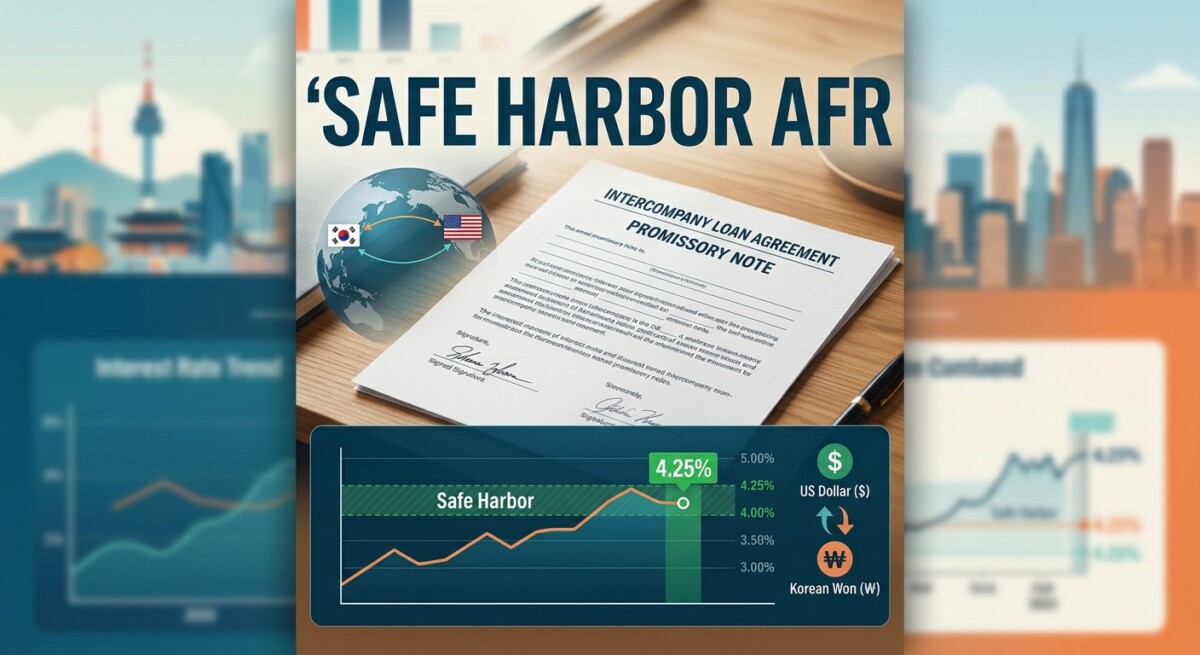
An intercompany loan from a Korean parent to its US subsidiary is deemed to carry an arm’s-length interest rate if the stated rate is at least 100% and no more than 130% of the Applicable Federal Rate (AFR) for a loan of the same term, compounded semi-annually, provided the loan meets the regulation’s threshold conditions.
Internal Revenue Code Section 482 lets the Commissioner reallocate income between controlled parties “to prevent evasion of taxes or clearly to reflect the income.” A loan is a controlled transaction, so the interest rate must satisfy the arm’s-length standard. Rather than make every related-party loan prove its rate from scratch, Treasury wrote a safe haven directly into the regulations.
Under Treasury Regulation Section 1.482-2(a)(2)(iii)(B), a stated interest rate is deemed arm’s length if, on the day the loan is executed or any later day on which the rate is set, that rate falls within a band of 100% to 130% of the AFR for a loan of comparable maturity, compounded semi-annually. In other words, the IRS will not challenge the rate as too high or too low if you stay inside that corridor.
The AFR comes in three term buckets, published monthly by the IRS on its Applicable Federal Rates page. Short-term AFR applies to loans of three years or less; mid-term AFR to loans over three and up to nine years; long-term AFR to loans over nine years. Match the AFR term to the stated maturity of your intercompany note, not to the planned repayment date.
Two threshold conditions matter. First, the safe haven applies only to loans denominated in US dollars; a KRW-denominated loan from the Korean parent does not qualify, and the rate must then be benchmarked another way — usually to arm’s-length rates on comparable third-party KRW loans. Second, the regulation itself still requires that the loan be a bona fide loan: a written note, fixed maturity, a repayment schedule, and a creditor-debtor relationship that is actually honored.
How do I pick the right AFR for a 2026 Korean parent loan? 📅
Match the AFR term bucket to the note’s stated maturity, lock the rate on the date of execution using that month’s Revenue Ruling, and store the printed AFR table in the loan file.
The IRS publishes the AFR each month in a Revenue Ruling, and the rates for the following month are usually released around the 15th through the 20th of the current month. A loan executed on, for example, December 3, 2026 would price off the December 2026 AFR tables. Pick the rate for the term that matches your note, in the compounding convention you select (semi-annual is the default referenced in the safe-haven text; annual, quarterly, and monthly tables are also published).
In our practice we see Korean parents default to the long-term AFR because the note’s economic reality is that it will not be repaid for many years. That instinct is right, but it has a tax cost: long-term AFR is almost always the highest of the three buckets, which means the US sub deducts more interest and the Korean parent recognizes more interest income (subject to US withholding). If cash is genuinely needed for working capital and will be repaid within three years, short-term AFR is fine and far cheaper.
A common mistake is pricing a revolving line of credit at long-term AFR because “it will probably roll for a long time.” Treasury Regulation Section 1.482-2(a) looks at the note’s stated maturity, not its expected rollover history. A demand loan or a one-year revolver prices at short-term AFR, period. If you want long-term AFR, write a long-term note.
What documentation does the IRS want on the loan? 📂
A written promissory note, a board resolution authorizing the borrowing, a repayment schedule, contemporaneous transfer-pricing documentation under Treas. Reg. Section 1.6662-6, and the annual Form 5472 disclosure of the loan balance and interest.
The arm’s-length rate is only half the question. Courts have recharacterized intercompany “loans” as capital contributions when the paperwork and the parties’ behavior did not look like real lending. The classic factors — a written note, a definite maturity, actual interest payments, no subordination to third-party debt, no linkage to earnings — are the ones a US revenue agent will walk through if they examine the arrangement.
Treasury Regulation Section 1.6662-6 adds a second layer. For transfer-pricing issues, the Section 6662(e) accuracy-related penalty can reach 20% of the understatement unless the taxpayer has “contemporaneous documentation” — a written transfer-pricing study prepared no later than the US tax return due date (with extensions) that explains the method, the comparables, and why the chosen rate is arm’s length. Reliance on the Section 1.482-2(a) safe haven itself can be the documentation if the loan clearly fits inside it, but the file still has to show you consciously selected the rate and the term.
Finally, Form 5472 is the information return that catches regulators’ attention. A US corporation (or a foreign-owned US disregarded entity) with 25% or more foreign ownership must file Form 5472 to report “reportable transactions” with its foreign related party, including the loan balance at year-end, interest accrued, and interest paid. The penalty for a missing or substantially incomplete Form 5472 is $25,000 per form per year, so this is a line item that routinely gets flagged in cross-border audits.
📌 CPA note from our practice
In our practice, the most common reason the IRS repriced a Korea-to-US intercompany loan was not the rate itself — the client had used AFR — but that no one had written a promissory note. The loan sat as “due to parent” on the US balance sheet for three years with no stated maturity and no interest ever paid. On exam, the IRS reclassified the balance as a capital contribution, which killed the interest deduction entirely and left the Korean parent with a dividend-equivalent recovery problem on repatriation. Write the note the day the money moves.
What other rules can trip up an intercompany loan rate from Korea? ⚠️
Three downstream limits can disallow or defer deductible interest even when the stated rate is inside the Section 482 safe harbor: Section 163(j) business interest expense limit, Section 267(a)(3) deferral until paid, and Section 267A anti-hybrid rules.
IRC Section 163(j) caps a corporation’s business interest expense deduction at 30% of its adjusted taxable income (ATI) for the year, with any excess carried forward. ATI is roughly taxable income without regard to business interest, net operating losses, Section 199A, and — for taxable years beginning after 2021 — depreciation and amortization. For an early-stage US subsidiary that is operating at a loss, ATI is often zero or negative, which means none of the interest to the Korean parent is deductible in the current year. The expense is not lost; it carries forward indefinitely. But it does not shelter current-year income.
IRC Section 267(a)(3) addresses the timing mismatch between a US accrual-basis payor and a related foreign payee. Interest accrued but not actually paid to a related foreign person is generally not deductible by the US sub until the year the interest is paid. For a Korean parent that leaves accrued interest on the US sub’s balance sheet for years before cash moves, this rule deferrs the entire deduction. In cross-border planning, running cash through the interest line each year — not just annually accruing it on paper — is how to keep the Section 163(j) carryforward from stacking up.
IRC Section 267A, enacted in 2017 and expanded by regulation, denies a US interest deduction on a payment to a related foreign party if the arrangement is a “hybrid” — most commonly, when the Korean parent is treated as fiscally transparent in Korea or when the instrument is treated as debt in the US and equity in Korea. For a Korean kabushiki kaisha-style stock company (주식회사) lending ordinary term debt, this rule usually does not bite. If the Korean side runs the arrangement through a check-the-box’d entity or a reverse hybrid, confirm with a Korean tax adviser how the interest income is characterized in Korea before you file the US return.
Separately, interest paid by a US sub to a Korean parent is subject to US withholding tax at 30% under the general nonresident alien rules, reduced by the US-Korea income tax treaty — which, under Article 13 of the treaty as currently in force, caps the rate on interest at 12% (and 0% for interest paid to the Korean government or Bank of Korea). The sub reports and remits the withholding on Form 1042-S and Form 1042.
⚠️ The three audit flags we see most
- No written note. “Due to parent” on the balance sheet with no promissory note is the single fastest way to lose debt characterization on exam.
- Interest accrued but never paid. Section 267(a)(3) parks the deduction until cash moves; a Korean parent cannot “lend” the interest back and still claim it.
- Form 5472 missing or incomplete. $25,000 per form per year, and failure here often triggers a broader cross-border examination.
What should I do before the loan is funded? ✅
Pick a term, pull the correct AFR for that term in the month of execution, write the note, document the choice in a one-page transfer-pricing memo, and set up Form 5472 bookkeeping on day one.
The sequence that keeps a Korean parent-US subsidiary loan clean is short and worth putting in a checklist before the wire hits:
| Step | What to do | Where it comes from |
|---|---|---|
| 1 | Set the stated maturity (short, mid, or long term) | Treas. Reg. §1.482-2(a)(2)(iii)(B) |
| 2 | Pull that month’s AFR table from the IRS Revenue Ruling | IRS AFR page |
| 3 | Pick a stated rate inside 100% – 130% of AFR; semi-annual compounding | Treas. Reg. §1.482-2(a)(2)(iii)(B) |
| 4 | Execute written promissory note with board resolution on both sides | Debt-vs-equity case law |
| 5 | Write a short memo citing the safe haven and the chosen AFR | Treas. Reg. §1.6662-6 |
| 6 | Set up Form 5472 ledger for Part IV reportable loan transactions | IRC §6038A; Form 5472 instructions |
| 7 | Model Section 163(j) ATI expected over the loan term | IRC §163(j) |
| 8 | Schedule actual interest cash payments to avoid Section 267(a)(3) deferral | IRC §267(a)(3) |
Running this sequence takes a few hours of professional time at the front end and prevents a multi-year transfer-pricing dispute at the back end. The alternative — booking the cash as a loan without a note, picking a round number for the rate, and reporting nothing on Form 5472 — is the pattern that creates most of the enforcement cases we see.
Summary — the intercompany loan rate rule set
- Pick a rate between 100% and 130% of the matching-term AFR, semi-annual compounding, and the IRS will not challenge the rate itself.
- Write the note, pass board resolutions, and keep interest cash moving — otherwise debt characterization fails before the rate question even comes up.
- File Form 5472 every year the loan is outstanding; the per-form penalty is $25,000.
- Model Section 163(j), Section 267(a)(3), and Section 267A on day one — any of them can defer or disallow interest that otherwise prices perfectly.
- Withholding on interest to the Korean parent is capped at 12% under the current US-Korea treaty; file Forms 1042 and 1042-S.
Frequently asked questions 🙋
Does the 100% to 130% AFR safe haven apply to loans in Korean won?
No. Treasury Regulation Section 1.482-2(a)(2)(iii)(B) applies by its terms to loans denominated in US dollars. A KRW-denominated loan must be benchmarked another way — most commonly by reference to arm’s-length rates on third-party KRW loans with comparable terms, which is a facts-and-circumstances analysis under the general arm’s-length standard of Section 1.482-1.
Can I set the intercompany loan rate at 0% and treat the imputation issue later?
Not safely. A stated rate below the AFR floor exits the safe haven and invites a Section 482 adjustment, and under IRC Section 7872 a below-market loan to a controlled corporation generates imputed interest. For a loan from a foreign parent to a US sub, the fix is almost always to state a rate inside the AFR corridor at inception rather than to clean up imputation at year-end.
Does the US sub have to withhold US tax on the interest paid to Korea?
Yes, by default — US-source interest paid to a foreign related party is subject to 30% withholding under Section 1442 unless a treaty reduces it. The US-Korea income tax treaty generally caps the interest rate at 12%, which the US sub applies by collecting a valid Form W-8BEN-E from the Korean parent and filing Forms 1042 and 1042-S annually.
What if the US sub never earns taxable income over the loan term?
The interest expense is still accrued on the books, but Section 163(j) limits the current-year deduction to 30% of adjusted taxable income. Any disallowed amount carries forward indefinitely until ATI is positive enough to absorb it. The expense is not lost; it is deferred.
Does Form 5472 need to be filed every year the loan is outstanding?
Yes. A 25%-foreign-owned US corporation (or a foreign-owned US disregarded entity) files Form 5472 each tax year it has a reportable transaction with a foreign related party. An outstanding loan balance and the related interest expense are reportable transactions, so Form 5472 is required every year the balance sits on the books.
Can the Korean parent charge a management fee on top of the loan interest?
It can, but each cross-border payment stands on its own under Section 482. A management fee requires its own arm’s-length pricing study — often based on actual services performed, with a markup appropriate to the function — and is reported on its own line of Form 5472. Combining a loan rate and a management fee into one blended charge does not simplify the file; it creates two unsupported numbers instead of one supported one.