Does NYC’s click to cancel rule apply to my company?
If your company sells a monthly app plan, a SaaS seat, a beauty box, a streaming tier or any other recurring product to people in the United States, the click to cancel rule that New York City’s Department of Consumer and Worker Protection (DCWP) put into effect on October 1, 2026 deserves a place on your compliance list. Many Korean founders and US subsidiaries of Korean companies assume that a consumer rule written by a city government only matters to businesses with a storefront in that city. That assumption is risky. Consumer protection rules generally follow where the customer is, not where the seller’s office is.
In this guide we walk through what the rule actually says, how it fits with the federal and state rules you may already know, what it costs to get it wrong, and a practical checklist for Korean-owned businesses that bill US consumers on a recurring basis. We also cover the part most compliance write-ups skip: what restitution and penalty exposure means for your books.
What does the NYC click to cancel rule actually require? 📋
It requires clear upfront disclosure of subscription terms, a cancellation method as easy as sign-up and available through the same medium, no obstruction of cancellation, and timed reminder notices before renewals, price changes and trial conversions.
The rule adds a new Part 8, “Click to Cancel,” to Title 6 of the Rules of the City of New York (6 RCNY §§ 5-110 through 5-110.3). It was proposed on April 8, 2026, heard publicly on May 8, 2026, and took effect on October 1, 2026, according to DCWP’s Notice of Adoption. It covers two types of arrangements:
- Automatic renewal — a paid subscription that renews at the end of a definite term for another term (for example, an annual plan that rolls over).
- Continuous service — a subscription that keeps running until the consumer cancels (for example, a month-to-month app plan).
For either type, a business making the offer to a consumer must do the following:
- Disclose material terms before asking for consent or billing details. The description of the product, the amount charged, how often, the deadline to stop further charges, and how to cancel must appear clearly and conspicuously, close to the consent request. If there is a free trial, gift or temporary price, the offer must explain how and when the price changes and what the later price will be.
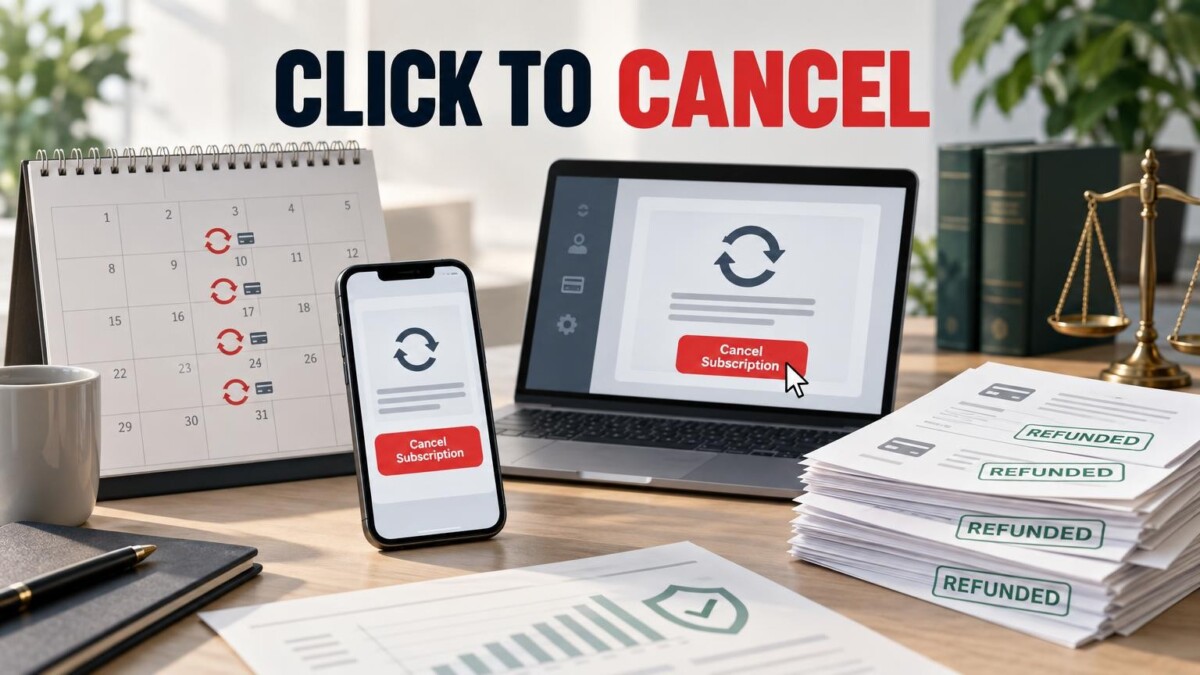
- Offer a cancellation method that is as easy as the sign-up method and in the same medium. If the customer subscribed online, they must be able to cancel online.
- Allow cancellation through every medium you accept for consent. If you accept sign-ups by app, website and phone, cancellation must work through all three. If consent was taken in person, you must also offer an online cancellation option such as a website or email.
- Not obstruct, ignore or unreasonably delay cancellation. The rule names hanging up on callers, hiding or misstating how to cancel, and misrepresenting the cost or consequences of cancelling.
- Not send unordered goods and expect payment. Products shipped under a subscription without affirmative consent are treated as an unconditional gift; the consumer owes nothing, including return shipping.
Which reminder notices must a subscription business send? ⏰
Three notices with fixed timing windows: renewal reminders for longer plans, notice of material term changes, and a reminder before a longer free trial converts to paid.
This is where many product teams fall short, because the notices must be sent through the channel the consumer selected — text, email, app notification or any other channel the business offers — and each renewal or trial reminder must include instructions on how to cancel.
| Notice | When it applies | Timing window |
|---|---|---|
| Renewal reminder | Initial paid term of one year or longer that renews for a paid term of six months or longer | 15 to 45 days before the cancellation deadline |
| Material change notice (including price increases) | Any accepted automatic renewal or continuous service offer | 5 business days to 30 days before the change |
| Free trial conversion reminder | Free gift or trial longer than one month, followed by a charge | 3 to 21 days before the cancellation deadline for the first paid period |
Note the “no earlier than” side of each window. A reminder sent 60 days before an annual renewal does not satisfy a 15-to-45-day requirement. Billing systems that send one generic email at a fixed interval often miss this.
Does the click to cancel rule reach a company with no office in New York? 🌏
Potentially yes. The rule regulates offers made to consumers in New York City, and it does not carve out sellers located elsewhere — so a Korean app or SaaS company with New York City subscribers should plan as if it applies.
The rule is built on New York City’s Consumer Protection Law (Administrative Code § 20-700 and following), which prohibits deceptive and unconscionable trade practices in the sale of consumer goods and services. Under § 5-110.1(a), it is a deceptive and unconscionable trade practice for any person to offer or provide an automatic renewal or continuous service to a consumer except in accordance with the rule. Nothing in the text limits it to businesses with a physical location in the city.
How actively the city can pursue a seller with no US presence is a separate legal question for counsel. But for a company that already has a US subsidiary, a US payment processor account, or a US app-store presence, the practical answer is simple: assume your New York City customers are covered, and design one cancellation flow that satisfies the strictest standard you face.
Three questions help size your exposure:
- Do you sell to consumers? The rule protects consumers. A purely enterprise B2B contract is generally outside it, but a self-serve plan paid with a personal card looks like a consumer transaction.
- How many of your US subscribers are in New York? Your payment data (billing ZIP codes) will tell you quickly.
- What does your current cancellation flow look like? Most subscription billing platforms support self-serve cancellation. The risk usually sits in custom retention screens built on top.
💡 CPA Insight
In our practice, Korean founders often run US subscription revenue through a Korean entity at first and only later move it to a US subsidiary. Consumer rules like this one do not care which entity books the revenue — they look at the customer. When we review a new US expansion plan, we ask for a billing-ZIP breakdown of US subscribers early, because it drives sales tax, consumer-law exposure and refund reserves all at once.
What are the click to cancel penalties and refund obligations? 💸
Civil penalties are $525 for a first violation, $1,050 for a second and $3,500 for each third or later violation, plus restitution of every amount charged after the consumer’s first attempt to cancel.
DCWP added the rule to its penalty schedule at 6 RCNY § 6-47. The amounts are the same whether the business answers the violation or defaults:
| Violation | Penalty |
|---|---|
| First violation | $525 |
| Second violation | $1,050 |
| Third and subsequent violations | $3,500 |
Restitution under § 5-110.2 is the piece finance teams should watch. A business found in violation is liable for the amount charged for the subscription after the consumer’s first attempt at cancellation. For a subscription business, a flawed flow is rarely one violation — it is the same defect repeated for every subscriber who hit it. A retention screen that blocked cancellations for a year can turn into a refund obligation covering months of charges per customer.
On October 1, 2026, the city also launched an online complaint portal at nyc.gov/click-to-cancel, and the DCWP announcement lists the practices consumers are invited to report: unclear terms, difficult or delayed cancellation, unrequested products, unannounced term changes and undisclosed auto-renewal. A portal that makes complaints easy tends to produce enforcement leads.
⚠️ Common mistake: retention offers that block the exit
Retention offers are not banned. Under § 5-110.1(e)(2), you may present a discount, a retention benefit or information about the effect of cancelling — but not in a way that imposes unreasonable conditions on cancelling, refuses to acknowledge the request, obstructs it or unreasonably delays it. A mandatory multi-screen “are you sure?” sequence, or forcing an online subscriber to call, is exactly what the rule targets. Keep a clear “cancel now” path visible on every retention screen.
If the FTC rule was struck down, why does any of this still matter? ⚖️
Because the federal statute behind online subscription enforcement still stands, and states and cities have filled the gap with their own, often stricter, rules.
The Federal Trade Commission’s amended Negative Option Rule — widely called the federal “click to cancel” rule — was vacated by the U.S. Court of Appeals for the Eighth Circuit on July 8, 2025, before its main provisions took effect. The court’s concern was the agency’s rulemaking procedure, not the idea of easy cancellation. Several things did not change:
- ROSCA still applies. The Restore Online Shoppers’ Confidence Act (15 U.S.C. §§ 8401–8405) is a statute passed by Congress. It requires clear disclosure of material terms, express informed consent before charging, and simple mechanisms to stop recurring charges for online negative-option sales.
- FTC enforcement continues case by case. DCWP’s own adoption notice cites FTC settlements that required a “simple mechanism to cancel.”
- State laws are in force. New York’s own automatic renewal statute, General Business Law § 527-a, already requires clear terms, affirmative consent and a cancellation mechanism as easy as the consent mechanism. California’s automatic renewal law, including Business and Professions Code § 17602, imposes similar duties. DCWP’s notice also lists Utah, Idaho, Massachusetts, Georgia, Minnesota, Colorado, Illinois and Arkansas as states with their own click-to-cancel style laws.
According to DCWP, the city rule is “fully consistent” with New York’s General Business Law approach, but goes further on three points: its own penalty amounts, its restitution provision, and the requirement to offer cancellation through every medium used for consent (plus an online option for in-person sign-ups). For a company selling nationwide, the result is a patchwork, much like state sales tax. The efficient approach is to build one flow that meets the strictest requirements, rather than tuning it state by state.
Who is exempt from the NYC click to cancel rule? 🏦
Mainly regulated financial and franchised businesses — not app, SaaS or e-commerce subscription sellers.
Section 5-110.3 exempts:
- Services provided by a business (or its affiliate) operating under a franchise issued by a New York State political subdivision, such as a cable franchise;
- Entities regulated by the New York Department of Financial Services, and their subsidiaries and affiliates;
- Security alarm operators licensed by the New York Department of State;
- Banks, bank holding companies, credit unions and other licensed financial institutions, and their subsidiaries and affiliates; and
- Sellers and administrators of service contracts as defined in New York Insurance Law § 7902.
DCWP specifically declined to exempt wireless and telecommunications providers, noting that commenters did not identify any federal rule that already imposes a click-to-cancel requirement on them. If your business is a typical consumer app, content platform, subscription box or SaaS tool, assume no exemption applies.
How should a Korean company’s finance team prepare? ✅
Audit the subscription lifecycle end to end, fix the cancellation and notice gaps, and reflect any refund exposure in your books and tax filings.
Product and legal teams own the user interface and the legal interpretation. Finance owns the numbers that follow. A practical checklist:
- Map your US subscribers by location. Pull billing ZIP codes from your payment processor and identify New York City, New York State and California customers.
- Test every sign-up channel against a cancel path. Web, iOS, Android, phone, in-person events or pop-up stores. Each sign-up medium needs a matching cancel option, and in-person sign-ups need an online option too.
- Review pre-consent disclosures. Price, billing frequency, cancellation deadline and how to cancel must appear next to the “subscribe” button — not only in the terms of service.
- Rebuild reminder timing. Configure renewal, price-change and trial-conversion notices to land inside the required windows, through the customer’s chosen channel, with cancel instructions included.
- Log every cancellation attempt. Restitution is measured from the consumer’s first attempt. Timestamped records of cancellation requests are your best defense and the basis for any refund calculation.
- Book refund liabilities where needed. Under US GAAP revenue recognition (FASB ASC 606), amounts you expect to refund are not revenue; if you identify charges made after unprocessed cancellation attempts, record a refund liability rather than waiting for a complaint.
- Coordinate refunds with sales tax. In states where your subscription is taxable, refunding a charge may also affect the sales tax you reported on it. Track refunds by jurisdiction so your returns stay accurate.
- Brief your Korean headquarters. Parent-company reporting packages should disclose material contingencies. A known defect in a US cancellation flow is the kind of item auditors will ask about.
📌 Key Takeaways
- New York City’s click to cancel rule (6 RCNY Part 8) has applied since October 1, 2026 to automatic renewal and continuous service subscriptions sold to consumers.
- Cancellation must be as easy as sign-up, in the same medium, and available through every medium used for consent.
- Penalties are $525, $1,050 and $3,500 per violation, plus restitution of charges after the first cancellation attempt.
- The FTC rule was vacated in 2025, but ROSCA and state automatic renewal laws still apply — build one flow to the strictest standard.
Frequently asked questions ❓
Does the NYC click to cancel rule apply if we have no office or employees in New York?
It can. The rule applies to any person offering an automatic renewal or continuous service to a consumer, and it does not exclude sellers located outside the city. If you have subscribers in New York City, plan as if it applies and confirm the enforcement question with counsel.
Can we still show a discount offer when a customer tries to cancel?
Yes, as long as the offer does not impose unreasonable conditions on cancelling or obstruct or unreasonably delay the request. The customer must be able to decline the offer and complete the cancellation without extra hurdles.
Our customers subscribe through Apple or Google app stores. Are we covered?
The rule regulates the person making the subscription offer. App-store billing usually provides a built-in cancellation path, but your own in-app disclosures, reminder notices and any web or phone sign-up channels still need to meet the rule. Review each channel separately.
Is a B2B SaaS subscription covered?
The rule is a consumer protection rule, so a contract with a business customer is generally outside it. A self-serve plan an individual buys with a personal card may be treated as a consumer transaction, so mixed B2B/B2C products should follow the rule for self-serve tiers.
How much refund exposure could we face?
Restitution equals the amount charged after the consumer’s first attempt to cancel. Multiply the monthly charge by the months billed after each blocked attempt, across every affected subscriber, and add penalties of $525 to $3,500 per violation. Cancellation logs are essential to measure and limit this.
Is there still a federal click to cancel rule?
The FTC’s amended Negative Option Rule was vacated by the Eighth Circuit on July 8, 2025. However, the Restore Online Shoppers’ Confidence Act still requires clear disclosures, express consent and simple cancellation for online recurring charges, and the FTC continues to enforce it.
Subscription compliance touches product design, legal interpretation and your financial statements at the same time. If your company bills US consumers on a recurring basis and you want help sizing refund exposure, setting up refund reserves or aligning sales tax on refunds, our team works with Korean companies and Korean-American business owners across the United States.