How much is US corporate tax in 2026? (Federal 21% + state)
How much is US corporate tax in 2026? A US C-corporation pays a flat 21% federal corporate income tax on its taxable income, plus a state corporate tax that ranges from 0% to about 9.8% depending on where it is organized and where it actually does business. The real bill often lands higher once state minimum taxes, franchise taxes, the accumulated earnings tax, and treaty withholding on dividends are included.
If you are a Korean-American founder setting up a C-corp, or a Korean parent sending capital into a US subsidiary, the first question is almost always the same: what is the real US corporate tax number? The honest answer is that there is one headline rate — 21% at the federal level — and a long list of items that stack on top of it. This guide walks through each layer from primary IRS and state sources, so you can map the full cost before you form, operate, or repatriate.
What is the US corporate tax rate at the federal level in 2026? 🇺🇸
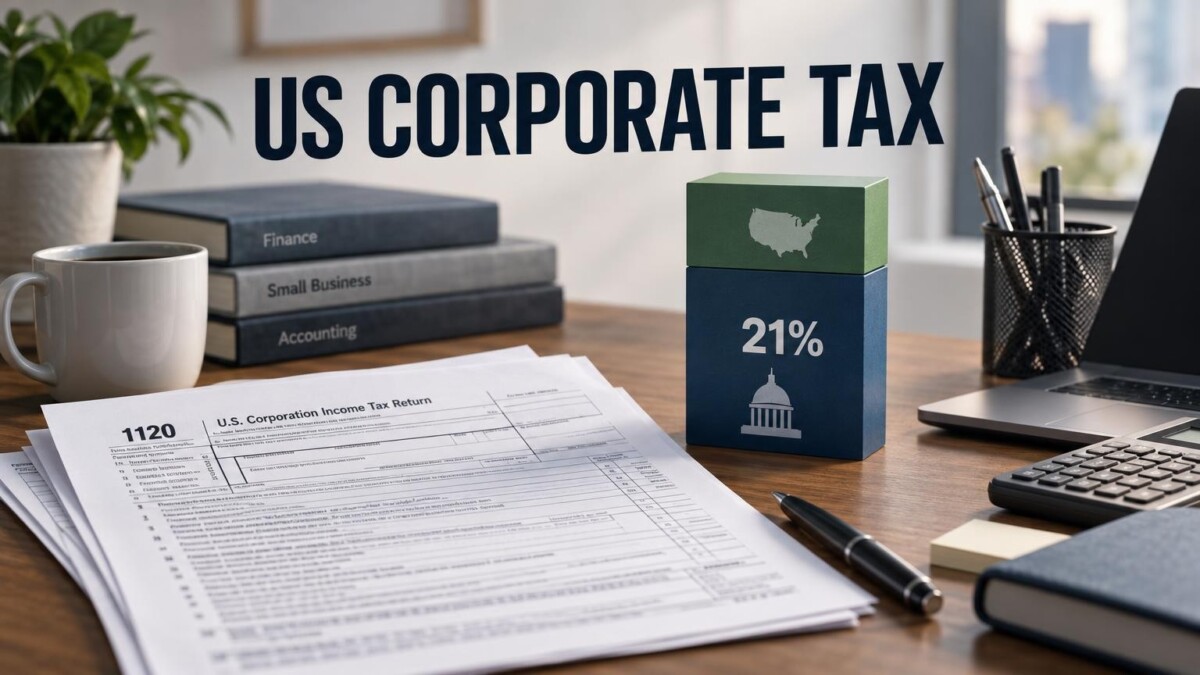
The federal rate is a flat 21% on a C-corp’s taxable income — there are no brackets, no small-business rate, and no income threshold.
The authority is 26 U.S. Code § 11. Subsection (b) reads, in full: “The amount of the tax imposed by subsection (a) shall be 21 percent of taxable income.” That flat 21% replaced the pre-2018 graduated bracket (15%–35%) when Congress passed the Tax Cuts and Jobs Act, and the 2025 One Big Beautiful Bill Act did not change it. A C-corp reports its taxable income on IRS Form 1120.
Two consequences follow from a flat rate:
- Small profits do not get a lower rate. A C-corp with $10,000 of taxable income pays 21% on it. There is no equivalent of the personal 10% bracket for a small corporation.
- Big profits do not get a higher rate either. The 15% corporate alternative minimum tax under IRC § 55 applies only to very large corporations with over $1 billion in average adjusted financial statement income, so it is not an issue for most founder-owned C-corps.
How much state corporate tax does a US company pay on top of that? 🗺️
States layer on their own corporate tax at rates roughly from 0% to 9.8%, and the choice of state almost never eliminates the bill because the tax follows where the business actually operates, not where it was formed.
A C-corp with any US footprint will usually owe corporate income tax or an equivalent gross-receipts or franchise tax to one or more states. The spread is wide:
| State | How it works | Headline rate / fee |
|---|---|---|
| California | Corporate franchise tax on net income; $800 minimum each year | 8.84% on net income — see the California Franchise Tax Board |
| Delaware | Annual franchise tax based on authorized shares (not income) for Delaware-formed corporations not doing business in Delaware | From $175 to $200,000+ — see the Delaware Division of Corporations |
| Texas | No corporate income tax, but a margin-based franchise tax | See the Texas Comptroller |
| Wyoming, South Dakota, Nevada, Washington, Ohio | No traditional corporate income tax; some have gross-receipts or margin taxes | Annual report fees still apply |
| New Jersey, Minnesota, Illinois | Corporate income tax at the upper end of the US range | Roughly 9%–9.8% headline — check each state’s department of revenue |
Two practical rules follow from how states assert nexus:
- Formation state ≠ taxing state. A Wyoming LLC taxed as a C-corp that opens an office or hires employees in California is subject to California’s 8.84% franchise tax and the $800 annual minimum. The California FTB’s own guidance is that “a foreign corporation that does not qualify with the SOS, but does business in California, is subject to the franchise tax.”
- Zero-income-tax does not mean zero cost. Texas has no corporate income tax but a margin-based franchise tax; Washington runs a Business and Occupation (B&O) tax; Ohio has a Commercial Activity Tax. “No state tax” states have gross-receipts or franchise substitutes that often hit sooner than an income tax does.
What other taxes stack on top of the 21% US corporate tax? ⚠️
A C-corp that quietly piles up cash — and never pays a dividend or a reasonable salary — can trigger the Accumulated Earnings Tax, a separate 20% federal tax on top of the 21% corporate rate.
The authority is 26 U.S. Code § 531, which imposes “an accumulated earnings tax equal to 20 percent of the accumulated taxable income.” The definition of accumulated taxable income, and the credit that lets a normal operating company keep working capital on hand, sit in 26 U.S. Code § 535.
The key threshold is the minimum accumulated earnings credit in § 535(c)(2):
- $250,000 for a typical operating corporation.
- $150,000 for a corporation whose principal function is the performance of services in health, law, engineering, architecture, accounting, actuarial science, performing arts, or consulting.
Below that floor, the AET is essentially not a problem. Above it, the IRS can assess the extra 20% unless the company can show the retained cash is needed for a reasonable business purpose — a documented expansion plan, a product line build-out, a working-capital model. Good contemporaneous documentation is what wins AET examinations; a bare balance sheet is not enough.
A smaller but parallel regime, the Personal Holding Company tax, applies another 20% rate under 26 U.S. Code § 541 on closely held corporations that earn mostly passive income. A Korean-American family holding company that parks investments in a C-corp without an operating business can land here.
Warning — “zero state tax” states still charge fees: Forming in Wyoming or Delaware to avoid California’s 8.84% works only if the company does not actually do business in California. If it does — one employee, one office, one warehouse — the California minimum $800 franchise tax and the 8.84% corporate rate apply. Expect to pay the formation-state annual fees and the operating-state tax, not one or the other.
How much US corporate tax does a Korean parent really pay to get the money home? 🔄
Once a Korean parent repatriates US profits as a dividend, the combined US federal corporate tax, state tax, and treaty withholding typically lands in the high 20s to low 30s percent, before Korean domestic tax.
The arithmetic stacks like this for a US C-corp subsidiary owned by a Korean parent:
- Federal corporate tax — 21% on US taxable income under IRC § 11(b).
- State corporate tax — 0% to roughly 9.8%, depending on where the subsidiary operates.
- Dividend withholding on repatriation — under the US-Korea income tax treaty, a US company paying a dividend to a Korean corporate shareholder that owns at least 10% of the paying company is generally subject to a 10% withholding rate (15% for other cases). The withholding is collected at source by the US payor and reported to the IRS.
Mechanically, the federal income tax and the state income tax come off first (on Form 1120), the after-tax earnings become distributable, and the treaty-reduced withholding comes off the dividend. Korea then re-taxes the dividend in the parent’s hands, with a foreign tax credit for the US tax paid. The combined effective rate varies with the state footprint and the shareholder’s Korean domestic position.
In our practice — the mistake we see most.
Korean-American founders often optimize for the formation state and ignore the operating state. We have reviewed cases where a Wyoming or Delaware C-corp spent a year running sales and support out of California, and only learned at the first tax season that California treated it as a foreign qualifier doing business in California — triggering back-year minimum $800 franchise taxes, estimated-tax penalties, and 8.84% on net income allocated to California. The federal 21% was never the surprise; the state assertion was.
Which legal structures lower the real US corporate tax bill? 🧩
The rate itself is fixed. What moves the bill is entity choice, reasonable compensation, and how profits leave the corporation.
A few of the levers that actually matter in practice:
- C-corp versus flow-through. An LLC taxed as a partnership or an S-corp election avoids the 21% corporate layer entirely — income is taxed only once at the owner level. But US-based S-corp status is not available to a nonresident alien shareholder, so a Korean parent that wants a single tax layer usually cannot use S-corp.
- Reasonable compensation. Salaries paid to shareholder-employees are deductible against corporate income (so they come off before the 21% is applied), while dividends are not. The IRS can recharacterize unreasonably high salaries as disguised dividends, so the compensation level has to match market and role.
- Royalties and intercompany services. A Korean parent that licenses IP or provides services to the US subsidiary can pull taxable income out of the US base, but the pricing has to meet the arm’s-length standard, and the US treats related-party payments under Section 482. Setting a defensible transfer price in advance is cheaper than defending one later.
- QSBS for founders. If the company qualifies as a Qualified Small Business under IRC § 1202 and the stock is held long enough, a founder-shareholder may exclude a significant portion of the gain on a future sale. This does not reduce the ongoing corporate tax, but it changes the end-state math meaningfully for venture-scale companies.
Summary — what a US corporation actually pays
- Federal corporate income tax: flat 21% under IRC § 11(b).
- State corporate tax: roughly 0% to 9.8%, assessed where the business operates, not where it was formed.
- Accumulated Earnings Tax: extra 20% on undistributed profits above the $250,000 ($150,000 for professional services) credit, unless the retention has a documented business purpose.
- Dividend withholding on repatriation to a Korean corporate parent: typically 10% under the US-Korea treaty when the parent owns ≥10%.
Frequently asked questions about US corporate tax ❓
Does a small US corporation pay a lower corporate tax rate than a big one?
No. The federal corporate income tax under IRC § 11(b) is a single 21% rate on taxable income with no brackets. A C-corp with $5,000 of taxable income pays 21%, and so does one with $5 million.
If I form my corporation in a zero-tax state like Wyoming, do I avoid state corporate tax entirely?
Not if the company does business elsewhere. States assert corporate tax jurisdiction based on where the business operates — payroll, property, sales, physical presence, or economic nexus. A Wyoming corporation operating in California still pays the California minimum $800 franchise tax and 8.84% on California-sourced income.
What triggers the Accumulated Earnings Tax, and how is it 20% separate from the 21%?
The AET under IRC § 531 is an additional 20% federal tax imposed on a C-corp that retains earnings beyond the reasonable needs of the business. It applies on top of the regular 21% corporate tax. The § 535(c)(2) minimum credit is $250,000 for operating companies and $150,000 for professional service corporations; above that, undistributed earnings need to be supported by a documented business purpose.
How much US tax does a Korean parent pay when the US subsidiary sends a dividend home?
The underlying US profits are first taxed at the 21% federal rate plus state corporate tax. On the dividend itself, the US-Korea income tax treaty generally limits US withholding to 10% when the Korean parent owns at least 10% of the US payer (15% in other cases). Korea then re-taxes the dividend at the parent level, with a foreign tax credit for the US tax paid.
Is it better to run profits out as salary, dividends, or royalties from a US corporation?
Salaries to shareholder-employees are deductible at the corporate level (reducing the 21% base), but they have to be reasonable for the services performed. Dividends are not deductible. Intercompany royalties and service fees are deductible only if they meet the arm’s-length standard under IRC § 482; aggressive related-party pricing invites IRS adjustment. The right mix depends on the shareholder’s residence, the Korean parent’s structure, and the business’s cash needs.
Did the 2025 One Big Beautiful Bill Act change the US corporate tax rate?
No. The federal corporate income tax under IRC § 11(b) remains a flat 21%. The 2025 legislation adjusted a number of individual and international provisions, but it left the headline C-corporation rate untouched.
This article is general information based on US federal and state primary sources current as of 2026. It is not individualized tax or legal advice; your facts control the outcome. Confirm with a US CPA before acting.